Paul Craig Roberts: Let Them Eat Cake: "It is not unusual for members of the diminishing upper middle class to drop $20,000 or $30,000 on a big wedding. But for celebrities this large sum wouldn’t cover the wedding dress or the flowers.
When country music star Keith Urban married actress Nicole Kidman in 2006, their wedding cost $250,000. This large sum hardly counts as a celebrity wedding. When mega-millionaire real estate mogul Donald Trump married model Melania Knauss, the wedding bill was $1,000,000.
The marriages of Madonna and film director Guy Ritchie, Tiger Woods and Elin Nordegren, and Michael Douglas and Catherine Zeta-Jones pushed up the cost of celebrity marriages to $1.5 million.
Tom Cruise and Katie Holmes upped the ante to $2,000,000.
Now comes the politicians’s daughter as celebrity. According to news reports, Chelsea Clinton’s wedding to investment banker Mark Mezvinsky on July 31 is costing papa Bill $3,000,000. According to the London Daily Mail, the total price tag will be about $5,000,000. The additional $2,000,000 apparently is being laid off on US Taxpayers as Secret Service costs for protecting former president Clinton and foreign heads of state, such as the presidents of France and Italy and former British Prime Minister Tony Blair, who are among the 500 invited guests along with Barbara Streisand, Steven Spielberg, Oprah Winfrey, Ted Turner, and Clinton friend and donor Denise Rich, wife of the Clinton-pardoned felon.
Before we attend to the poor political judgment of such an extravagant affair during times of economic distress, let us wonder aloud where a poor boy who became governor of Arkansas and president of the United States got such a fortune that he can blow $3,000,000 on a wedding.
The American people did not take up a collection to reward him for his service to them.
Where did the money come from? Who was he really serving during his eight years in office?
How did Tony Blair and his wife, Cherrie, end up with an annual income of ten million pounds (approximately $15 million dollars) as soon as he left office? Who was Blair really serving?
These are not polite questions, and they are infrequently asked.
While Chelsea’s wedding guests eat a $11,000 wedding cake and admire $250,000 floral displays, Lisa Roberts in Ohio is struggling to raise contributions for her food pantry in order to feed 3,000 local people, whose financial independence was destroyed by investment bankers, job offshoring, and unaffordable wars. The Americans dependent on Lisa Roberts’ food pantry are living out of vans and cars. Those with a house roof still over their heads are packed in as many as 14 per household according to the Chillicothe Gazette in Ohio.
The Chilicothe Gazette reports that Lisa Roberts’ food pantry has ‘had to cut back to half rations per person in order to have something for everyone who needed it.’
Theresa DePugh stepped up to the challenge and had the starving Ohioans write messages on their food pantry paper plates to President Obama, who has just obtained another $33 billion to squander on a pointless war in Afghanistan that serves no purpose whatsoever except the enrichment of the military/security complex and its shareholders.
The Guardian (UK) reports that according to US government reports, one million American children go to bed hungry, while the Obama regime squanders hundreds of billions of dollars killing women and children in Afghanistan and elsewhere.
The Guardian’s reporting relies on a US government report from the US Department of Agriculture, which concludes that 50 million people in the US--one in six of the population--were unable to afford to buy sufficient food to stay healthy in 2008.
US Department of Agriculture Secretary Tom Vilsack said that he expected the number of hungry Americans to worsen when the survey for 2010 is released.
Today in the American Superpower, one of every six Americans is living on food stamps.
The Great American Superpower, which is wasting trillions of dollars in pursuit of world hegemony, has 22% of its population unemployed and almost 17% of its population dependent on welfare in order to stay alive.
The world has not witnessed such total failure of government since the final days of the Roman Empire. A handful of American oligarchs are becoming mega-billionaires while the rest of the country goes down the drain.
And the American sheeple remain acquiescent.
Paul Craig Roberts was an editor of the Wall Street Journal and an Assistant Secretary of the U.S. Treasury. His latest book, HOW THE ECONOMY WAS LOST, has just been published by CounterPunch/AK Press. He can be reached at: PaulCraigRoberts@yahoo.com"
Saturday, July 31, 2010
Paul Craig Roberts: Let Them Eat Cake


Friday, July 30, 2010
Steven Weber: Making Degrade
Steven Weber: Making Degrade: "
The steady erosion of American productivity and viability may not just be unfortunate happenstance or a natural socioeconomic evolution, but a premeditated, consolidated effort to reap reward from fomenting failure.
And, as an interesting bit of collateral damage, people no longer have any faith in someone or something unless there's money involved, hence the curiously adhesive qualities of the moronic quasi libertarian meme of preferring the unregulated shenanigans of the private sector over a democratically elected and regulated government. And here's where those people who have been able to free themselves from the 24-hour-a-day opiate known as The Media slap themselves in their heads and say 'Sheesh!'
But as evidenced by the steady reduction of overall quality in ideals America once prided itself on (i.e., productivity, creativity, education, the democratic process) and the attendant illogic of such routine breakdowns of formerly reliable concepts (i.e., quality control, protecting the welfare of all its citizens), there is the sinking feeling that the country that was built upon the highest ideals by those whose grasp of power, history and human nature, has been subsumed by those who revile such high aims. In fact, the guys that run things now have pasted 'Fire Sale' over 'We the People.' And they're cashing in.
The culprit is, of course, the corporate mentality, a plague that manifests in the unrelenting consumption of disposable goods and useless services to maximize profit at the expense of people.
Like the icons she worships, like the plastic personalities digitally downloaded into our daily feeds, America's overriding principle is no longer one of thrift, service and civility but an obsession with things wasteful and divisive. That's our latest and greatest export.
Just because it sometimes feels good to scratch a mosquito bite until it bleeds, let's take Sarah Palin, for instance. The self-styled Mama Grizzly is actually the embodiment of the current fetish for failure, a bespectacled avatar of the mediocre intelligence and misguided ambition that is the hallmark of today's American idol.
While never having been in possession of basic leadership skills, let alone insight into the classic workings of democracy and the awesome responsibility such knowledge should impart, she is instead a facade from a corporate costume shop. Strutting her secondary sexual characteristics and bleating whatever shallow Republican talking point flashes across her staff's iPads, she nonetheless continues to be a leader of the gormless mass who raise fists and rail against that black guy in office and/or anything else she tells them to.
Then there is Jabber the Hate himself, Rush Limbaugh. The undisputed king of caustic right wing vitriol has made it his mission to destroy, divide, delude, and in so doing drive his profits through the roof of what must be a mammoth McMansion, proportionate in volume to his gargantuan ego.
And then there's that confounding blight, which is the so-called Tea Party, the latest Sam's Club clumping of the angry-for-whatever-reason volkische who seek only quick fixes to simplistically labeled problems, loathe their villains and embrace their heroes no matter how inane or discredited their reasoning. Deprived of a decent education and livelihood by the very forces with which they are aligned, they among all other obstacles to progress remain the most frustrating to observe, as the power to effect positive change is in their hands. It's their minds which have been highjacked.
And somewhere in this mishegoss, someone is making a shitload of dosh.
And guess what -- they're right in front of you exhorting you to fear immigrants, hate government, love Big Oil, hate the poor, fear the president and on and on. The right wing loves to court the least informed and most in pain. Because that's how they make their money. They've created a mass of Yokelsteins.
Don't get me wrong: Americans -- be angry! Assemble in the town squares! Take your representatives to task!
But while you're at it, read a book. Or two. Thumb through a reputable newspaper. Go to Europe. Have a conversation with someone from a feared and despised culture. Avail yourselves of the many sources and perspectives out there on the internet, hovering like fruit just waiting to be picked.
Discover agendas. Suss out key investors in places that insist they are trustworthy (*cough* Saudi Arabia and Fox News *cough, cough*). Realize that things are not as fair and balanced as the talking heads are telling you they are.
And then maybe we can get back to some kind of reason and stability. As history has shown repeatedly in the lifespans of many an empire, our days as the greatest superpower on Earth may be waning, and those who revel in the pride that defined our greatest, boldest days might not be willing to relax their desperate grip on such a regrettable reality.
But given the preponderance of proof that the powers that be are making moolah from mass misery, we must not forsake our opportunity to reclaim some civility, dignity and sense, three things that those corporate fascisto-capitalist dickheads who are stoking cynicism and despair for fun and profit detest.
Bad for business, you see.
"(Via Huffington Blog.)
Thursday, July 29, 2010
This week in Change
(updated below)
I'm still away for the week working on my book, but in order to create a new comment section and to illustrate our political culture of Change, I'd like to note these three incidents from this week:
First, in Collapsing Empire News, the Democratic House -- not deterred or even slowed in the least by what the WikiLeak-ed documents revealed -- voted overwhelmingly to appropriate unconditionally another $37 billion for the war in Afghanistan while the political class prepares massive teacher lay-offs and (coming soon) slashing cuts to Social Security; this action -- with 102 Democrats and 12 Republicans opposed -- was taken in violation of the emphatic pledge of virtually every Democratic politician not to fund wars through supplemental appropriations. Perfectly illustrating how our political culture functions, one of the GOP House members to vote against the war funding (Jason Chaffetz of Utah) is now being attacked by his Democratic challenger, Karen Hayer, with the type of Rovian rhetoric that poisoned the country for the last decade (Chaffetz is 'irresponsibly' failing to 'support our men in uniform who are currently in harms way'); Greg Sargent has more on what this role reversal means.
Second, as was painfully predictable and predicted, the bulk of political discussion in the wake of the WikiLeaks disclosures focuses not on our failing, sagging, pointless, civilian-massacring, soon-to-be-decade-old war, but rather on the Treasonous Evil of WikiLeaks for informing the American people about what their war entails. While its true that WikiLeaks should have been much more careful in redacting the names of Afghan sources, watching Endless War Supporters prance around with righteous concern for Afghan lives being endangered by the leak is really too absurd to bear. You know what endangers innocent Afghan lives? Ten years of bombings, checkpoint shootings, due-process-free hit squads, air attacks, drones, night raids on homes, etc. etc.
Numerous government officials are predictably threatening not only WikiLeaks' sources with criminal prosecution, but WikiLeaks itself. That, of course, would be a major escalation of the Obama administrations war on whistle blowing leaks, which already easily surpasses the war waged by the Bush administration. And while some TV 'journalists' are clearly receptive to such suggestions (MSNBCs Savannah Guthrie yesterday seemed downright excited by, even insistent on, such prosecutions), allowing prosecutions not for those who leak classified information, but also for those who receive and publish it, would obviously allow criminal sanctions to be aimed at journalists who publish or report on classifed information.
Third, the Obama administration is now advocating changes to the law that would empower federal law enforcement agents to compel companies to turn over citizens' Internet records without a warrant or any other form of judicial oversight. I wrote previously about the Obama DOJs extremely dubious (and dangerous) arguments in court that the law already allows them to access such Internet and email records with no warrant, but now they are attempting to have Congress re-write the law to vest them with that power. Kevin Drum, Marcy Wheeler, and Adam Serwer have more on what this very significant expansion of oversight-free Surveillance State powers would mean.
So theres your Week in Change: tens of billions more appropriated for war through supplemental spending tricks and without conditions or timetables, attacks on war opponents for being Troop-Haters, threats to criminally prosecute journalistic outlets (such as WikiLeaks) which publish classified information on the grounds of being Traitors, and a major expansion of the Governments ability to spy on your private communications without even obtaining warrants. And its only Thursday morning, so think how much more Change can happen in the next two days.
UPDATE: A new ACLU Report examines the first 18 months of Obama's civil liberties record and documents how his embrace of the prior administration's policies has transformed Bush/Cheney radicalism into the 'new normal.'
(Via Salon: Glenn Greenwald.)
Tuesday, July 27, 2010
Robert Reich: The Great Decoupling of Corporate Profits From Jobs
Robert Reich: The Great Decoupling of Corporate Profits From Jobs: "
Second-quarter earnings reports are coming in, and they're making Wall Street smile. Corporate profits are up. And big American companies are sitting on a gigantic pile of money. The 500 largest non-financial firms held almost a trillion dollars in the second quarter, and that money pile is growing larger this quarter. Profits that plummeted in the recession have bounced back. Big businesses have recovered almost 90 percent of what they lost.
So with all this money and profit, they'll start hiring again, right? Wrong - for three reasons.
First, lots of their profits are coming from their overseas operations. So that's where they're investing and expanding production.
GM now sells more cars in China than it does in the US, but makes most of them there. The company now employs 32,000 hourly workers in China. But only 52,000 GM hourly workers remain in the United States - down from 468,000 in 1970.
GM isn't just hiring low-tech assembly workers in China. Last week the firm broke ground there on a $250 million advanced technology center to develop batteries and other alternative energy sources.
You and I and other American taxpayers still own over 60 percent of GM. We bought GM to save GM jobs, remember?
GM officials say no American taxpayer money is being used to expand in China. But money is fungible. Because of our generosity, GM can use the dollars it doesn't have to spend in the United States meeting its American payroll and repaying its creditors for new investments in China.
Second, big U.S. businesses are investing their cash in labor-saving technologies. This boosts their productivity, but not their payrolls.
Last Friday, for example, Ford reported a $2.6 billion second-quarter profit. The firm is already more than two-thirds the way to equaling its record 1999 profits. But due to labor-saving technologies, Ford now has half as many employees as it did a decade ago.
Wall Street analysts are happy with Ford's 'commitment to keeping capacity in check,' according to the Wall Street Journal. Ford shares rose 5.2 percent Friday. 'Keeping capacity in check' is the Street's way of saying 'no new hiring.' In fact, the Street is advising investors to sell the stocks of companies that talk openly of expanding capacity.
Finally, corporations are using their pile of money to pay dividends to their shareholders and buy back their own stock - thereby pushing up share prices.
Last Friday, GE announced it would raise its dividend by 20 percent and reinstate its share-buyback plan. It's GE's first dividend increase since the company cut its dividend in early 2009. As a result, GE shares are up more than 5% in the past few days.
Bottom line: Higher corporate profits no longer lead to higher employment. We're witnessing a great decoupling of company profits from jobs.
The next supply-side economist who tells you companies need more incentive (i.e. lower taxes) before they'll hire is living on another planet.
The reality is this: Big American companies won't begin to think about hiring until they know American consumers will buy their products. The problem is, American consumers won't start buying against until they know they have reliable paychecks.
This post originally appeared at RobertReich.org.
"
(Via Huffington Blog.)
Are the American people obsolete?
Are the American people obsolete?: "
Have the American people outlived their usefulness to the rich minority in the United States? A number of trends suggest that the answer may be yes.
"(Via Salon.)
Friday, July 23, 2010
Why has the Post series created so little reaction?
Why has the Post series created so little reaction?: "
Remember how The Washington Post spent three days documenting on its front page that we basically live under a vast Secret Government -- composed of military and intelligence agencies and the largest corporations -- so sprawling and unaccountable that nobody even knows what it does. This public/private Secret Government spies, detains, interrogates, and even wages wars in the dark, while sucking up untold hundreds of billions of dollars every year for the private corporations which run it. Has any investigative series ever caused less of a ripple than this one? After a one-day spate of television appearances for Dana Priest and William Arkin -- most of which predictably focused on the bureaucratic waste they raised along with whether the Post had Endangered the Nation by writing about all of this -- the story faded blissfully into the ether, never to be heard from again, easily subsumed by the Andrew Breitbart and Journolist sagas.
Any doubt about whether thered be any meaningful (or even cosmetic) changes as a result of the Post exposé (it was really more a compilation of already know facts) was quickly dispelled by the reaction of the political class: not just one of indifference, but outright contempt for the concerns raised by this story. On Tuesday, the Senates Homeland Security Committee removed a provision from the Intelligence Authorization Act which would have provided some marginally greater oversight over the Government's secret intelligence programs, because Obama was threatening to veto any bill providing for such oversight. Then, Obamas nominee to be the next Director of National Intelligence, Ret. Lt. Gen. James Clapper, all but laughed at the Post's work, dismissing it during his Senate confirmation hearing as 'sensationalism,' praising the bureaucratic redundancies as 'competitive analysis,' and insisting that the National Security and Surveillance State are perfectly 'under control.' The Post's Jeff Stein today documents how Congressional Democrats can barely rouse themselves to the pretense that they intend to do anything to impose any restraints or accountability on Top Secret America. And it was revealed this week by McClatchy that our vaunted 'withdrawal of all combat troops from Iraq' will be accomplished only by assembling a privatized militia that will serve as the State Department's 'army in Iraq' long after our actual army 'withdraws.'
Political elites dont even feel compelled to pretend to be able or willing to do anything about this. Just think about this: on Monday, the Post documents a vast Secret Government bequeathed with unimaginable secrecy and unaccountability, and the rest of the week is filled with stories of the administration blocking greater oversight and plans to escalate the privitization of our National Security and Surveillance State. Thats why there was so little government angst over the Posts 'revelations': aside from the fact that it revealed little that wasnt already known (Priest and Arkin withheld substantial amounts of information at the Governments request), even the impact of having the Post trumpet these facts was not a threat to much of anything, since theres nobody in a position to do much about this even if they wanted to. And few people seem to want to.
Its not hard to understand why. Why would the political class possibly want to subvert or weaken their ability to exercise vast spying, detention, and military powers in the dark? They dont. Beyond that, as the Post series highlights, Top Secret America provides not only the ability to exercise vast power with no accountability, but also enables the transfer of massive amounts of public wealth to the private national security and surveillance corporations which own the Government. Nobody with political power has the incentive -- to say nothing of the ability -- to do anything about that. Its probably best not to hold your breath waiting for Dianne Feinstein -- the Democratic Chairwoman of the Senate Intelligence Committee who lives in lavish wealth as a result of her husband's investments in the National Security State (and whose Senate career has a way of oh-so-coincidentally bolstering their wealth) -- to meaningfully address any of the issues raised by the Post series. Despite Feinsteins rhetoric to the contrary, doing so is decidedly not in her interests for multiple reasons.
What ties together virtually every political issue is the one highlighted in this new article in The Nation by Vermont Sen. Bernie Sanders. Entitled 'No to Oligarchy,' it documents with an array of facts how Americas wealth is rapidly becoming more concentrated in a tiny number of families while the middle class essentially disappears. As Sanders emphasizes, the outcome is not only the destruction of the 'American dream,' but serious threats to very concept of a republican form of government:
Today, because of stagnating wages and higher costs for basic necessities, the average two-wage-earner family has less disposable income than a one-wage-earner family did a generation ago. The average American today is underpaid, overworked and stressed out as to what the future will bring for his or her children. For many, the American dream has become a nightmare.
But, not everybody is hurting. While the middle class disappears and poverty increases the wealthiest people in our country are not only doing extremely well, they are using their wealth and political power to protect and expand their very privileged status at the expense of everyone else. This upper-crust of extremely wealthy families are hell-bent on destroying the democratic vision of a strong middle-class which has made the United States the envy of the world. In its place they are determined to create an oligarchy in which a small number of families control the economic and political life of our country.
The 400 richest families in America, who saw their wealth increase by some $400 billion during the Bush years, have now accumulated $1.27 trillion in wealth. Four hundred families! During the last fifteen years, while these enormously rich people became much richer their effective tax rates were slashed almost in half. While the highest-paid 400 Americans had an average income of $345 million in 2007, as a result of Bush tax policy they now pay an effective tax rate of 16.6 percent, the lowest on record.
Last year, the top twenty-five hedge fund managers made a combined $25 billion but because of tax policy their lobbyists helped write, they pay a lower effective tax rate than many teachers, nurses and police officers. As a result of tax havens in the Cayman Islands, Bermuda and elsewhere, the wealthy and large corporations are evading some $100 billion a year in U.S. taxes. . . .
But its not just wealthy individuals who grotesquely manipulate the system for their benefit. Its the multinational corporations they own and control. In 2009, Exxon Mobil, the most profitable corporation in history made $19 billion in profits and not only paid no federal income tax—they actually received a $156 million refund from the government. In 2005, one out of every four large corporations in the United States paid no federal income taxes while earning $1.1 trillion in revenue.
Sanders quotes Teddy Roosevelt in 1910 explaining why a graduated estate tax was not only economically just but -- more important -- crucial to maintaining basic democratic values:
The absence of effective state, and, especially, national restraint upon unfair money-getting has tended to create a small class of enormously wealthy and economically powerful men, whose chief object is to hold and increase their power. The prime need is to change the conditions which enable these men to accumulate power which is not for the general welfare that they should hold or exercise.
What was once a word that only the most UnSerious of people would utter as applied to the U.S. -- 'oligarchy' -- is today one that cant be avoided if one wants accurately to describe our political culture. Sanders warns of an 'oligarchy in which a handful of wealthy and powerful families control the destiny of our nation.' The second-ranking Senate Democrat, Dick Durbin, extraordinarily confessed last year that it is Wall Street banks which 'frankly own' the Congress. In virtually every area, the subservience of Government to large business interests is so complete that it's impossible to find the line where government ends and corporate power beings. Its a full-scale merger. Thats the central fact of our political life. Most everything else is a distraction.
Thats why its simultaneously so astounding and so unsurprising to watch the obscene spectacle unfold that is inevitably leading to cuts in Social Security. In his New York Times column today, Paul Krugman accurately observes that Republicans are attempting to rehabilitate Bush because they are the same GOP with the same platform as prevailed throughout the last decade, just decorated with some re-branding. Thats all clearly true, but what isnt quite true is this paragraph:
In recent weeks, G.O.P. leaders have come out for a complete return to the Bush agenda, including tax breaks for the rich and financial deregulation. They've even resurrected the plan to cut future Social Security benefits.
It is absolutely beyond the Republicans power to cut Social Security, even if they re-take the House and Senate in November, since Obama will continue to wield veto power. The real impetus for Social Security cuts is from the 'Deficit Commission' which Obama created in January by Executive Order, then stacked with people (including its bipartisan co-Chairs) who have long favored slashing the program, and whose recommendations now enjoy the right of an up-or-down vote in Congress after the November election, thanks to the recent maneuvering by Nancy Pelosi. The desire to cut Social Security is fully bipartisan (otherwise it couldnt happen) and pushed by the billionaire class that controls the Government.
The secret, omnipotent National Security State highlighted by The Washington Post will endure and expand as is because those who control the Government (or, as Dick Durbin, who 'own' it) benefit endlessly from it. Major scandals or citizen-infuriating crises can sometimes lead to some modest and easily circumvented restraints being placed on this power (as just happened with the recently enacted Financial Regulation bill), largely to placate public rage, but its simply impossible to conceive of the political class taking any meaningful steps to rein in a limitlessly powerful and unquantifiably profitable National Security and Surveillance State -- at least in the absence of serious citizen revolts against it. That Post series produced so little reaction because what it describes -- a Secret Government bestowed with the most extreme powers yet accountable to nobody -- is something to which the nation, as part of our State of Endless War, has apparently acquiesced as a permanent and tolerable condition.
(Via Salon: Glenn Greenwald.)
Thursday, July 22, 2010
Sherrod Asks President Obama the Right Question: Do You Believe in My Principles?
Sherrod Asks President Obama the Right Question: Do You Believe in My Principles?: "
I guessed this one wrong. I told colleagues early this week I thought Vilsack would apologize and offer Shirley Sherrod her job back, and that she’d hestitate. But I thought President Obama would then call her personally and close the deal — and that this was the WH plan for escaping the political hole they foolishly walked into.
Well, it seems Shirley Sherrod is a better person than I am and definitely smarter than the political disaster-kabuki directors in the White House. This morning, she told the media she doesn’t need an apology from the President, but wouldn’t mind talking to him, to acquaint him with some realities from her life that he may not understand. And she needs to be convinced that he — the President of the United States — believes in, and will fight for, the principles she cherishes and he claims to hold.
The video above is her interview on the Today show, well worth watching (though why is the interviewer giving any credibility to Breitbart, given his proven, serial dishonesty?). More from the AP:
Sherrod said of Obama: ‘I’d like to help him see some of the things that he could do in the future.’
‘I really regret what they did. But as I said before, he’s my president,’ Sherrod said. ‘When you get it down to where the rubber meets the road, I think you need to understand a little more what life is like. I’d love to talk to him, though, or people in his administration … to help them understand.’
‘I can’t say that the president is fully behind me. I would hope that he is,’ she added. ‘I would love to talk to him.’
What an interesting idea. What unusual behavior by a citizen. Ask your President, or any elected official or candidate, ‘how do I know you care about the things that are important to me? What have you experienced or learned that’s relevant to the real problems I know? Why should I believe you, especially after how badly you’ve behaved?’ . . .
Wouldn’t it be something if the President and Congress had to answer those questions from people of color, and women, and working people and the unemployed, . . . or just voters? And letting them know, in public, that you won’t let them off the political hook until you’re satisfied? What an interesting notion for how a citizen relates to her government.
Everyone has underestimated this woman. Shirley Sherrod is asking the right questions, and we should all be demanding better answers.
John Chandley
More:
MSNBC’s Morning Joe, where everyone wants to apologize and offer Sherrod a job.
"(Via Firedoglake.)
David Sirota: Its the Tax Cuts and Wars, Stupid
David Sirota: It's the Tax Cuts and Wars, Stupid: "
In a terrific column for Tax.com, Pulitzer-Prize winner David Cay Johnston breaks down new government data and puts USA Today's whole 'lowest tax bills since 1950' revelation into dollars and cents we can all understand:
In 1979 federal taxes for the median-income household totaled $6,100, but in 2007 taxes slipped to $6,000. That $100 decline, measured in 2007 dollars, understates what a bargain taxes have become. Back in 1979 federal taxes equaled 18.7 percent of comprehensive household income. By 2007 incomes had grown 28 percent in real terms, so the tax burden not only dropped in absolute dollars, it also fell as a share of median comprehensive income to 14.4 percent. So over 28 years median income has risen in real terms by $9,100 while federal taxes have fallen by $100.
As Johnston points out, this is not something you hear very much about from journalists -- or as he puts it, 'those who play journalists on television talk shows.' And you certainly don't hear it from congressional Republicans or rank-and-file conservatives, who continue to bewail allegedly high taxes as our biggest problem, despite the real emergency of cash-strapped communities now slashing police forces, tear up roads and even outsource entire municipal workforces.
Indeed, what you hear from conservatives -- if anything -- on spending issues is that allegedly profligate domestic expenditures are supposedly running up all-too-big deficits. But again, that runs you straight back into the government data, as reported by the Center on Budget and Policy Priorities:
Some commentators blame recent legislation -- the stimulus bill and the financial rescues -- for today's record deficits. Yet those costs pale next to other policies enacted since 2001 that have swollen the deficit. Those other policies may be less conspicuous now, because many were enacted years ago and they have long since been absorbed into CBO's and other organizations' budget projections. Just two policies dating from the Bush Administration -- tax cuts and the wars in Iraq and Afghanistan -- accounted for over $500 billion of the ($1.4 trillion) deficit in 2009 and will account for almost $7 trillion in deficits in 2009 through 2019.

That graph really says it all -- if you are genuinely concerned about deficits, then you should be concerned not about domestic spending, but about spending on the Bush tax cuts and wars (and this doesn't even mention the bloated defense budget that is, according to National Journal, on course to be the biggest in a single presidential term since World War II).
That's the real tax and spend story that conservatives don't want told.
"(Via Huffington Blog.)
Monday, July 19, 2010
The Real U.S. Government
The Washington Post's Dana Priest demonstrates once again why she's easily one of the best investigative journalists in the nation -- if not the best -- with the publication of Part I of her series, co-written with William Arkin, detailing the sprawling, unaccountable, inexorably growing secret U.S. Government: what the article calls 'Top Secret America.' To the extent the series receives much substantive attention (and I doubt it will), the focus will likely be on the bureaucratic problems it documents: the massive redundancies, overlap, waste, and inefficiencies which plague this 'hidden world, growing beyond control' -- as though everything would better if Top Secret America just functioned a bit more effectively. But the far more significant fact so compellingly illustrated by this first installment is the one I described last week when writing about the Obama administration's escalating war on whistle blowers:
Most of what the U.S. Government does of any significance -- literally -- occurs behind a vast wall of secrecy, completely unknown to the citizenry. . . . Secrecy is the religion of the political class, and the prime enabler of its corruption. That's why whistle blowers are among the most hated heretics. They're one of the very few classes of people able to shed a small amount of light on what actually takes place.
Virtually every fact Priest and Arkin disclose underscores this point. Here is their first sentence: 'The top-secret world the government created in response to the terrorist attacks of Sept. 11, 2001, has become so large, so unwieldy and so secretive that no one knows how much money it costs, how many people it employs, how many programs exist within it or exactly how many agencies do the same work.' This all 'amounts to an alternative geography of the United States, a Top Secret America hidden from public view and lacking in thorough oversight.' We chirp endlessly about the Congress, the White House, the Supreme Court, the Democrats and Republicans, but this is the Real U.S. Government: functioning in total darkness, beyond elections and parties, so secret, vast and powerful that it evades the control or knowledge of any one person or even any organization.
Anyone who thinks thats hyperbole should just read some of what Priest and Arkin chronicle. Consider this: 'Every day, collection systems at the National Security Agency intercept and store 1.7 billion e-mails, phone calls and other types of communications.' To call that an out-of-control, privacy-destroying Surveillance State is to understate the case. Equally understated is the observation that we have become a militarized nation living under an omnipotent, self-perpetuating, bankrupting National Security State. Heres but one flavoring anecdote:
Command centers, internal television networks, video walls, armored SUVs and personal security guards have also become the bling of national security.
'You cant find a four-star general without a security detail,' said one three-star general now posted in Washington after years abroad. 'Fear has caused everyone to have stuff. Then comes, If he has one, then I have to have one. Its become a status symbol.'
Whats most noteworthy about all of this is that the objective endlessly invoked for why we must acquiesce to all of this -- National Security -- is not only unfulfilled by 'Top Secret America,' but actively subverted by it. During the FISA debate of 2008 -- when Democrats and Republicans joined together to legalize the Bush/Cheney warrantless eavesdropping program and vastly expand the NSAs authority to spy on the communications of Americans without judicial oversight -- it was constantly claimed that the Government must have greater domestic surveillance powers in order to Keep Us Safe. Thus, anyone who opposed the new spying law was accused of excessively valuing privacy and civil liberties at the expense of what, we are always told, matters most: Staying Safe.
But as I wrote many times back then -- often by interviewing and otherwise citing House Intelligence Committee member Rush Holt, who has been making this point repeatedly -- the more secret surveillance powers we vest in the Government, the more we allow the unchecked Surveillance State to grow, the more unsafe we become. Thats because the public-private axis that is the Surveillance State already collects so much information about us, our activities and our communications -- so indiscriminately and on such a vast scale -- that it cannot possibly detect any actual national security threats. NSA whistle blower Adrienne Kinne, when exposing NSA eavesdropping abuses, warned of what ABC News described as 'the waste of time spent listening to innocent Americans, instead of looking for the terrorist needle in the haystack.' As Kinne put it:
By casting the net so wide and continuing to collect on Americans and aid organizations, its almost like theyre making the haystack bigger and its harder to find that piece of information that might actually be useful to somebody. Youre actually hurting our ability to effectively protect our national security.
The Government did not fail to detect the 9/11 attacks because it was unable to collect information relating to the plot. It did collect exactly that, but because it surveilled so much information, it was incapable of recognizing what it possessed ('connecting the dots'). Despite that, we have since then continuously expanded the Governments surveillance powers. Virtually every time the political class reveals some Scary New Event, it demands and obtains greater spying authorities (and, of course, more and more money). And each time that happens, its ability to detect actually relevant threats diminishes. As Priest and Arkin write:
The NSA sorts a fraction of those [1.7 billion e-mails, phone calls and other types of daily collected communications] into 70 separate databases. The same problem bedevils every other intelligence agency, none of which have enough analysts and translators for all this work.
The article details how ample information regarding alleged Ft. Hood shooter Nidal Hassan and attempted Christmas Day bomber Umar Abdulmutallab was collected but simply went unrecognized. As a result, our vaunted Surveillance State failed to stop the former attack and it was only an alert airplane passenger who thwarted the latter. So it isnt that we keep sacrificing our privacy to an always-growing National Security State in exchange for greater security. The opposite is true: we keep sacrificing our privacy to the always-growing National Security State in exchange for less security.
* * * * *
This world is so vast, secretive and well-funded that its very difficult to imagine how it could ever be brought under control. Thats particularly true given its inextricable intertwining with the private sector: the billions upon billions of dollars funneled from the Government to its private-sector 'partners,' which is the subject of the not-yet-published second installment of the Priest/Arkin article. As I wrote when examining the revolving public/private shuttling of former DNI and Booz Allen executive Michael McConnell:
In every way that matters, the separation between government and corporations is nonexistent, especially (though not only) when it comes to the National Security and Surveillance State. Indeed, so extreme is this overlap that even McConnell, when he was nominated to be Bush's DNI, told The New York Times that his ten years of working 'outside the government,' for Booz Allen, would not impede his ability to run the nation's intelligence functions. That's because his Booz Allen work was indistinguishable from working for the Government, and therefore -- as he put it -- being at Booz Allen 'has allowed me to stay focused on national security and intelligence communities as a strategist and as a consultant. Therefore, in many respects, I never left.'
As the NSA scandal revealed, private telecom giants and other corporations now occupy the central role in carrying out the government's domestic surveillance and intelligence activities -- almost always in the dark, beyond the reach of oversight or the law.
Long before the Priest/Arkin article, Tim Shorrock has been documenting this sprawling, secretive, merged public/private world that combines unchecked surveillance and national security powers with enormous corporate profits. So long as the word Terrorism continues to be able to strike fear in the hearts of enough citizens and media stars -- as Communism did before it -- the political class, no matter who is elected, will be petrified to oppose any of this, even if they wanted to, and why would they want to? They wouldnt and they dont. And it thus grows and becomes more powerful, all justified by endless appeals to The Terrorists.
Thats why it is difficult to imagine -- short of some severe citizen unrest -- how any of this will be brought under control. One of the few scenarios one can envision for such unrest involves growing wealth disparities and increasingly conspicuous elite corruption. In The New York Times today, investment banker and former Clinton Treasury official Roger Altman announced that the alleged 'tension between President Obama and the business community' can be solved only if the political class is willing to 'fix Social Security' -- i.e., to slash Americans retirement security. Sooner or later (probably sooner), one way or another (probably this way), thats going to happen. Its inevitable. As George Carlin put it several years ago, in an amazingly succinct summary of so many things:
And now, theyre coming for your Social Security money - they want your fucking retirement money - they want it back - so they can give it to their criminal friends on Wall Street. And you know something? Theyll get it. Theyll get it all from you sooner or later. Because they own this fucking place. Its a Big Club: and youre not in it.
Thats really the only relevant question: how much longer will Americans sit by passively and watch as a tiny elite become more bloated, more powerful, greedier, more corrupt and more unaccountable -- as the little economic security, privacy and freedom most citizens possess vanish further still? How long can this be sustained, where more and more money is poured into Endless War, a military that almost spends more than the rest of the world combined, where close to 50% of all U.S. tax revenue goes to military and intelligence spending, where the rich-poor gap grows seemingly without end, and the very people who virtually destroyed the world economy wallow in greater rewards than ever, all while the public infrastructure (both figuratively and literally) crumbles and the ruling class is openly collaborating on a bipartisan, public-private basis even to cut Social Security benefits?
* * * * *
The answer, unfortunately, is probably this: a lot longer. And one primary reason is that our media-shaped political discourse is so alternatively distracted and distorted that even shining light on all of this matters little. The New York Times' Peter Baker had a good article this weekend on how totally inconsequential squabbles dominate the news more or less continuously: last weeks riveting drama was the bickering between the White House and Nancy Pelosi over Robert Gibbs warning that Democratic control of the House was endangered. Baker quotes Democratic strategist Chris Lehane as follows: 'Politics in D.C. have become Seinfeldesque. Fights about nothing.'
If you read and write about politics full-time and are thus forced to subject yourself to the political media -- as I am -- whats most striking arent the outrages and corruptions, but the overwhelming, suffocating, numbing stream of stupidity and triviality that floods the brain. One has to battle the temptation to just turn away and ignore it all. Every day, day after day, is consumed by some totally irrelevant though distracting melodrama: what Sarah Palin wrote on her Facebook page, some 'outrageous' snippet of a comment made by John Boehner or Harry Reid, some 'crazy,' attention-attracting statement from some fringe idiot-figure or TV blowhard that is exploited for superficial partisan gain or distraction value (hey, look over there: I think Michelle Bachmann just said something outrageous!!!!). I cant recall an incident that better captures our political culture than this, from a Politico report on one of last week's fascinating Royal Court dramas -- the insult-trading between Palin and Mitt Romney:
Asked about the comments by POLITICO, a longtime Palin aide unloaded on Romney’s staff. . . . 'For Washington consultants to sit around and personally disparage the governor anonymously to reporters is unfortunate and counterproductive and frankly immature,' said the aide, who spoke on condition of anonymity.
A Palin aide, hiding behind Politico-granted anonymity, complaining that petty comments were made anonymously by a Romney aide: a perfect expression of what our politics are. The Drudge and Politico sewers still rule our world -- 'fights over nothing' -- and happily distract us from Top Secret America, what it does and what it takes.
And whatever these petty distractions fail to achieve, active media distortion takes care of the rest. This superb article by Mark Prendergast, the Ombudsman for Stars & Stripes, details the billions of dollars secretly (and probably illegally) spent by the Pentagon -- much of it on private contractors -- to subject not only foreign nationals but also American citizens to pure propaganda campaigns. The Pentagon propaganda program exposed by David Barstow is but a representative sliver of the weapons used by the National Security State and its private partners to control media behavior and shape public opinion. Billions upon billions of dollars are spent for this propagandistic purpose at exactly the time that real journalistic outlets are failing. Television journalists think theyre covering war zones when they submit to Pentagon embedding and then broadcast what theyre allowed to see, while repeating government lies about war without challenge. And when all else fails, were told to look over there at all those Bad, Evil things done by those Other Countries (hey, look at Pakistan, whose citizens are pumped full of myths and disinformation while their wealthy manipulate the law so as to not pay their fair share of taxes!! -- and Iran detains people without charges and China tortures!! -- can you believe them?).
Meanwhile, the Real U.S. Government -- the network of secret public and private organizations which comprise the National Security and Surveillance State -- expands and surveills and pilfers and destroys without much attention and with virtually no real oversight or accountability. It sucks up the vast bulk of national resources and re-directs the rest to those who own and control it. To their immense credit, Dana Priest and William Arkin will spend the week disclosing the details of what they learned over the past two years investigating all of this, but the core concepts have long been glaringly evident. But Sarah Palins Twitter malapropism from yesterday will almost certainly receive far more attention than anything exposed by the Priest/Arkin investigation. So well continue to fixate on the trappings and theater of government while The Real Government churns blissfully in the dark -- bombing and detaining and abducting and spying and even assassinating -- without much bother from anyone.
"(Via Salon: Glenn Greenwald.)
Thursday, July 15, 2010
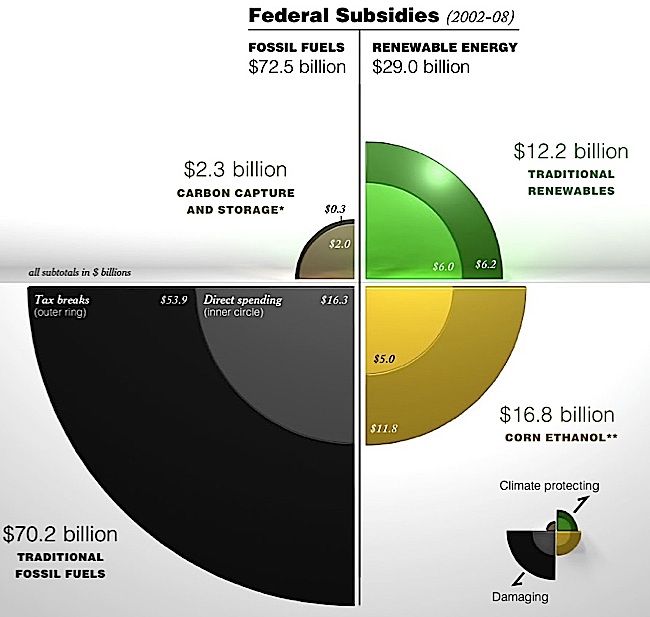
Subsidizing Fossil Fuels: $72 billion (vs $29 billion)
Subsidizing Fossil Fuels: $72 billion (vs $29 billion): "
I’m a gearhead. I like the sound a V8 or V12 makes when I mash down my right foot and those pretty butterflies open up.
But I am not unaware of the external costs of my hobbies. Which is why I found this research piece, titled Energy Subsidies Favor Fossil Fuels Over Renewables, rather interesting. It turns out, according tho this one analysis, that the vast majority of federal energy subsidies are for fossil fuels rather than to renewables or new alternative technologies: $72 billion vs $29 billion over the same period. (These are direct subsidies, tax breaks, etc., and do not include things like the military budget).
The question I have is given how wealthy Oil and natural gas firms are, why on earth are we subsidizing them at all?
>
>
The vast majority of subsidy dollars to fossil fuels can be attributed to just a handful of tax breaks,
Note: Almost half of the subsidies for renewables are attributable to corn-based ethanol.
>
Source:
Estimating U.S. Government Subsidies to Energy Sources: 2002-2008
Environmental Law Institute, September 2009
http://www.elistore.org/Data/products/d19_07.pdf
(Via The Big Picture.)
Shadow Housing Inventory: Two Houses for Every One for Sale
Shadow Housing Inventory: Two Houses for Every One for Sale: "
RealtyTrac, as reported on Housing Wire, gave a gloomy update on the US housing market. RealtyTrac does granular collection of data on foreclosures, capturing every filing. One of the shortcomings of this approach is that processes vary by state (as in some state require more court filings over the course of a foreclosure than others). In addition, homes can go in and out of foreclosure (an owner gets the first notice, contacts the servicer and works out a catch-up plan, and later falls behind again). So the commentary of RealtyTrac and other market participants is essential in interpreting the data.
The key takeaway:
James Saccacio, CEO of RealtyTrac, said at the current pace, more than 3m properties will receive a foreclosure filing by the end of the year, and lenders will repossess more than 1m of them. According to a report from the Toronto-based Capital Economics, the weight of the shadow inventory may contribute to a double dip in the housing market. The report found that for every home currently on the market, two homes are waiting to be sold.
‘The roller coaster pattern of foreclosure activity over the past 12 months demonstrates that while the foreclosure problem is being managed on the surface, a massive number of distressed properties and underwater loans continues to sit just below the surface, threatening the fragile stability of the housing market,’ Saccacio said.
Yves here. The scary part here is this estimate of market overhang refers only to foreclosed and distressed property. There is another category of hidden inventory, people who would like to sell but aren’t even listing their houses. These would include people who want to relocate, aging individuals who’d like to downsize and had hoped to be able to liberate some equity.
More detail from HousingWire:
"Foreclosure filings decreased 3% in June after another 3% drop in April. It’s the third straight month of declines. Foreclosure filings were down 7% from June 2009. Despite the recent downward swing, June marked the 16th straight month of more than 300,000 filings.
For the second quarter of 2010, foreclosures dropped 4% from Q110 and remained 1% above Q209. As default and auction notices fell, REOs increased 5% from the last quarter and 38% from Q209. It’s the most REOs measured in a quarter since RealtyTrac began publishing the reports in January 2005.
‘The second quarter was a tale of two trends,’ Saccacio said. ‘The pace of properties entering foreclosure slowed as lenders pre-empted or delayed foreclosure proceedings on delinquent properties with more aggressive short sale and loan modification initiatives. Meanwhile the pace of properties completing the foreclosure process through bank repossession quickened as lenders cleared out a backlog of distressed inventory delayed by foreclosure prevention efforts in 2009.’
(Via naked capitalism.)
The $4 Trillion Dollar Question
The $4 Trillion Dollar Question: "
I have been covering the US Real Estate market for decades. I grew up with RE (mom was a RE broker and an investor). I have been a housing bear for about 5 years. I recognized the credit bubble and inevitable bust long before most other analysts/strategists/economists did.
I mention this just to inform readers that it is very rare that I come across any housing analysis that surprises me or adds to my understanding of the real estate landscape in a major way.
Which is why I am so pleased to introduce you to Dhaval Joshi, Chief Strategist at London based hedge fund RAB Capital (and former Societe Generale and J P Morgan Strategist).
Dhaval’s analysis looks a variety of housing data relative to household formation, housing stock, vacancy rates, and inventory is not the typical housing review. It is quite illuminating.
Enjoy:
~~~
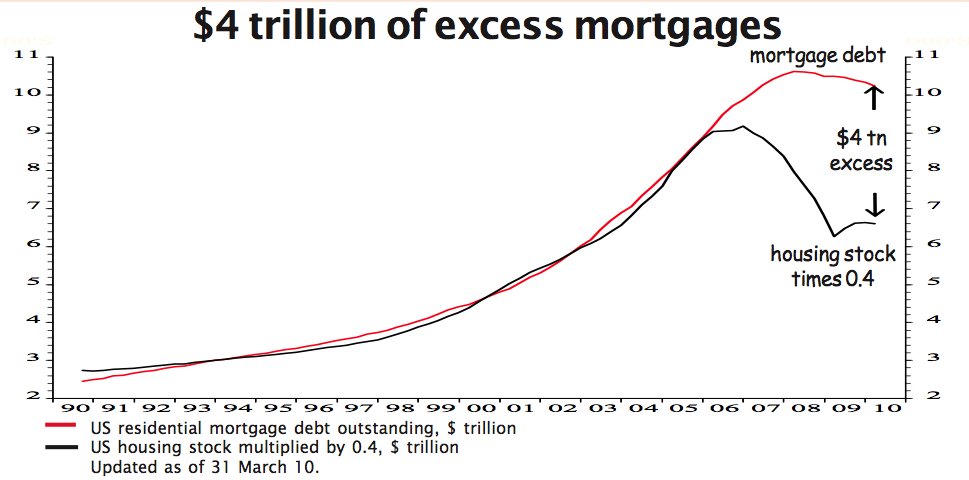
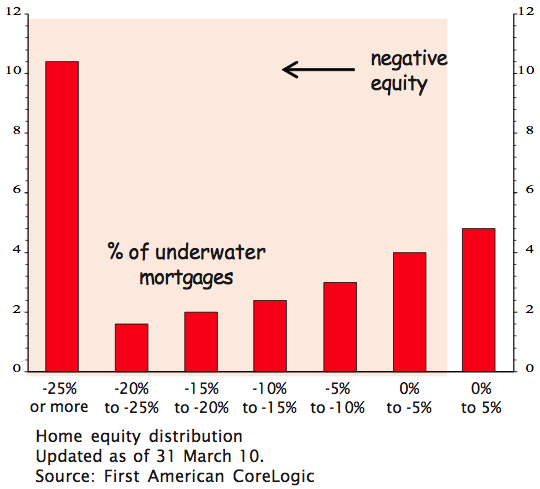
Can the US economy really return to ‘business as usual’ when it has 4 million houses surplus to requirement, when 1 out of 4 mortgages are in negative equity, and when by our calculation, it is burdened with $4 trillion of excess mortgage debt, equivalent to 30% of GDP?
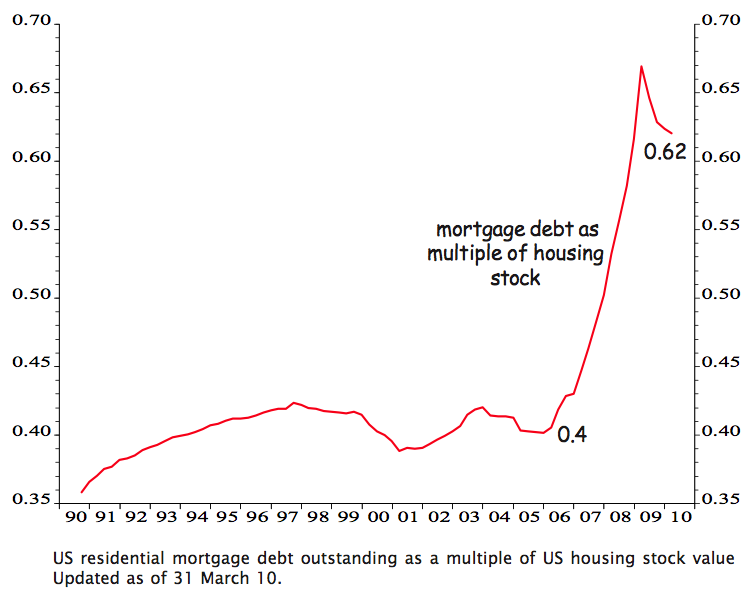
For many years, total mortgage debt consistently and reliably equalled 0.4 times the value of the US housing stock. Intuitively, this average of 0.4 makes perfect sense as every property usually has a mortgage ranging from 0 to 0.9 times its value. So in 1990, $6 trillion of housing collateral could support $2.5 trillion of mortgages, and by 2006, $23 trillion of housing collateral could support $10 trillion of mortgages. But since then, the US housing stock’s value has slumped to $16 trillion which means the amount of mortgage lending supportable by the collateral has plunged to $6 trillion. However, actual mortgage debt has remained at $10 trillion – $4 trillion too high.
The fact that mortgage debt has barely declined suggests that relatively few homeowners have defaulted on their mortgages or paid off debt yet. Instead, a quarter of all borrowers are sitting on negative equity. That’s just as well – because were mortgage debt to shrink by even half of $4 trillion, the US economy would slump.
Perhaps homeowners are patiently expecting house prices to rise again. But if so, they may be in for a long wait. Prices are likely to be weighed down by a massive oversupply of homes relative to underlying demographic demand. Whether you look at the houses to population ratio, the houses to household ratio or vacant houses ratio, the conclusion is the same – there is a 3% surplus of properties, equivalent to 4 million homes. And with household formation running at just 0.9 million while the US is still building 0.6 million new homes annually, only 0.3 million of the oversupply will be absorbed per year (see page 5).
Ultra low rates to stay
A recent study by the Federal Reserve (The Depth of Negative Equity and Mortgage Default Decisions by Bhutta, Dokko and Shan) investigated the question: at what point do underwater homeowners ‘strategically default’ on their mortgages? Surprisingly, it found that the average borrower doesn’t walk away from his home until negative equity reaches a very high level, -62%. But the fascinating thing was that there was something that could trigger underwater borrowers to default much, much earlier – and that something was an interest rate rise.
With a quarter of US mortgages underwater, and likely to stay that way for some time, the Fed must follow its own research if it wants to prevent a cascade of defaults. Hence, expect US interest rates to stay ultra low for an ultra long time.
>
>
For many years, total mortgage debt consistently and reliably equalled 0.4 times the value of the US housing stock. Intuitively, this average of 0.4 makes perfect sense as every property usually has a mortgage ranging from 0 to 0.9 times its value. So in 1990, $6 trillion of housing collateral could support $2.5 trillion of mortgages, and by 2006, $23 trillion of housing collateral could support $10 trillion of mortgages. But since then, the US housing stock’s value has slumped to $16 trillion which means the amount of mortgage lending supportable by the collateral has plunged to $6 trillion. However, actual mortgage debt has remained at $10 trillion – $4 trillion too high.
>
Loan to value ratio is 1.5 times too high
>
To put it another way, the loan to value ratio of total mortgages outstanding to housing stock value is currently 1.5 times too high.
>
24% of US mortgages are underwater

>
The fact that mortgage debt has barely declined suggests that relatively few homeowners have defaulted on their mortgages or paid off debt yet. Instead, a quarter of all borrowers are sitting on negative equity.
>
Higher interest rates may trigger cascade of defaults
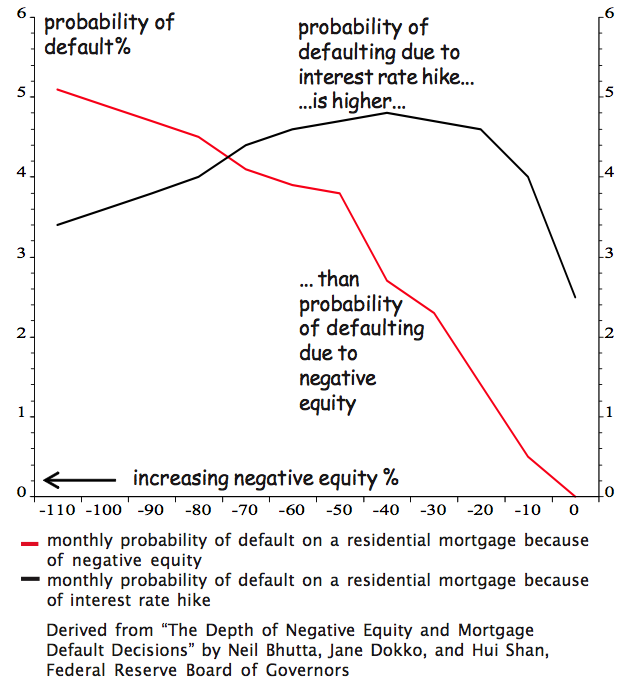
>
A recent study by the Federal Reserve investigated the central question: at what point do underwater homeowners ‘strategically default’ on their mortgages? Surprisingly, it found that when the decision is based on negative equity alone, the average borrower doesn’t walk away from his home until it is very underwater (negative equity of 62%). But the fascinating thing was that there was something that could trigger underwater borrowers to default much, much earlier – and that something was an interest rate rise. In fact, higher interest rates were even more significant in triggering defaults than higher unemployment.
With a quarter of US mortgages underwater, the Fed must heed the advice of its own research if it wants to prevent a cascade of defaults and the consequent repercussions on the financial system and the economy. Hence, expect US interest rates to stay ultra low until millions of mortgages escape out of negative equity.
>
The US has built far too many houses
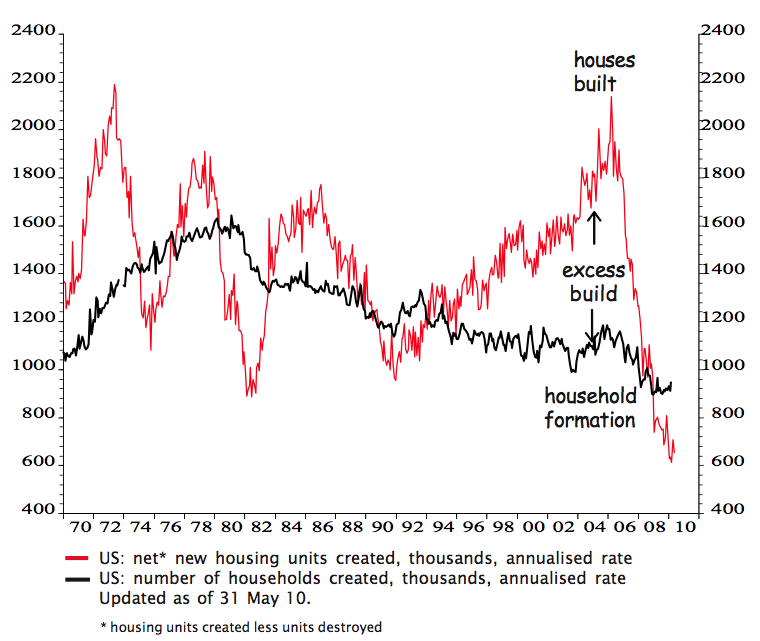
>
Perhaps homeowners suffering negative equity are patiently expecting house prices to rise again. But they may be in for a long wait. Prices are likely to be weighed down by a massive oversupply of homes relative to underlying demographic demand.
Between 2002 and 2006, US homebuilders went on a construction binge, building 12 million new homes while the number of households went up by just 7 million. The painful legacy is a massive oversupply of houses relative to the number of households.
>
The oversupply will take years to clear
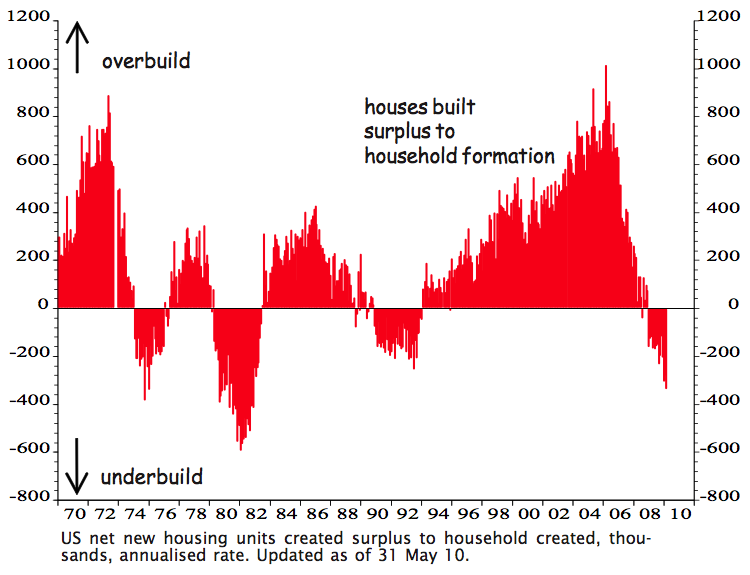
>
With household formation running at just 0.9 million while the US is still building 0.6 million new homes annually, only 0.3 million of the oversupply will be absorbed per year. As there are currently 4 million too many homes, it may take years to mop up the huge oversupply of houses.
"(Via The Big Picture.)
Wednesday, July 14, 2010
Leo Hindery, Jr.: Where Is the 2008 Barack Obama Now on Jobs and Trade?
Leo Hindery, Jr.: Where Is the 2008 Barack Obama Now on Jobs and Trade?: "
Although John Edwards had no business running for President in 2008 given the tawdry marital indiscretions that he was hiding from nearly everyone, including from his senior campaign team, he nonetheless clearly established the agenda on jobs (and labor) and trade for all of the Democratic candidates, especially as it later turned out for then Senator Obama.
Following Edwards' second-place finish in Iowa his other top advisor and I (at the time, I was serving as his Senior Economic Policy Advisor) compressed into a single 'manifesto' all of his statements over the prior year on these issues. For the short remainder of his campaign, he spoke continuously about keeping a robust number of manufacturing jobs in America, on the order of 20% of overall employment. He spoke of the need to forge a new partnership between organized labor and government. He pledged to make passing the Employee Free Choice Act (EFCA) a major and immediate priority and to passing a ban on hiring permanent replacement workers for strikers.
Concerning trade and globalization, we espoused investing the resources required for the U.S. to keep its competitive edge in the world, and asserted that our global trade needed to be based on four core principles:
1) First and foremost, America's trade agreements must provide clear and measurable benefits for American workers - and then they must be enforced. This means they must include prohibitions against illegal subsidies, currency manipulation and other trade abuses. It means they must protect U.S. national security-related manufacturing essential to our high-tech weaponry and defense.
2) America's trade policies must also lift up workers around the world, which is a combined moral, global economic and critical U.S. national security imperative. This means that our agreements must also provide strong protections for the global environment, and that we won't condone agreements with countries which ignore good governance, where there is violence against workers, or where workers are denied just wages and basic labor standards.
3) In negotiating trade agreements 'one size does not fit all', and thus America's trade agreements must account for significant differences in form of government, the rule of law, the relative maturity of economies, and common trade and business practices. Emphasis should therefore be placed mostly on fair and balanced bilateral and regional trade agreements, and not on multilateral global agreements such as Doha.
4) Restoring fair and balanced trade with China in all aspects must be a particular priority. We will do business with China, but we will not be pushed around or talked to death while they take our markets.
Senator Barack Obama on Jobs and Trade
Five months later, on July 2, 2008, Barack Obama embraced all of these commitments in a zinger of a speech to the United Steel Workers that I had the privilege to help write. This speech quickly became Senator Obama's own manifesto.
After being introduced by Edwards, Senator Obama said:
'Change is a President who welcomes you into the White House; who's walked with you on that picket line; who doesn't choke on the word 'union'; who lets unions do what they do best and organize our workers; and who will finally make EFCA the law of the land.
'Change is knowing that for trade to work for America, it has to work for all Americans; that we have to stand up to countries that are manipulating their currency or flooding our markets with subsidized goods; that it's wrong to have a 'one-size fits all' trade policy that treats countries as different as China and Mexico as if they were the same; that when workers are mistreated in sweatshops and labor leaders are threatened or even murdered abroad, it not only offends our conscience, it hurts our workers too; and that our job ends not when a trade deal is signed, but when it's enforced.
'Change is ending tax breaks for companies that ship jobs overseas and giving them to companies that create good paying jobs here in America; it's putting people to work...making the materials we need to rebuild America; it's...creating millions of new jobs - jobs that we want to be good union jobs - and giving our workers the skills to do them.'
SO, WHAT THE HECK HAPPENED FROM JULY 2, 2008 TO JULY 7, 2010?
With every good intention and with one of the most precise 'promise-full' agendas in the history of American electoral politics, Barack Obama sailed his new ship of state into the White House in January 2009. And then the 'gang who couldn't (or didn't want to) steer the ship straight' almost immediately ran his jobs and trade promises aground.
His key economic advisors - Larry Summers, Tim Geithner, Cristina Romer and Rahm Emanuel - must have, in this order, told the new President something like the following, for how else to explain the fact that over the succeeding eighteen months the defining commitments he made during his campaign were either abandoned or largely went for naught:
1) 'Pass the economic stimulus package we've designed, Mr. President, and the official unemployment rate won't get any higher than 8.5%. And because every earlier administration since 1947 did so, we're also going to keep ignoring the real unemployment figure even though for the first time since then there are as many uncounted unemployed Americans (15 million) as there are counted ones (15 million).'
2) 'We know you emphatically promised workers that EFCA would be one of the first things your new administration would tackle, but we're not going to do so. It isn't as if the Republicans in Congress are going to take up this mantle.'
3) 'Larry is giving a speech today [June 19, 2009] to the Foresight Symposium which is going to largely define our job creation efforts on your behalf during your first term. He plans to say that essentially a job is a job and that America's loss of manufacturing exports and jobs can be made up with exports of 'software, movies, medicine, university degrees, and management consulting and law firm services', which of course defies reality and contradicts every speech you gave during the Campaign in proud towns like Dayton and Flint.
4) 'Even though the issue of America having an industrial policy and trade policies that mirror the mercantilist practices of our major trading partners came up repeatedly during your campaign, we want you instead to repeatedly say that the combination of green energy technologies, exported services, and new free trade agreements or FTAs will sufficiently revitalize the American economy.'
5) 'Despite your even more explicit promise about immediate and complete reform of our trading with China, we want you to effectively ignore China's massive illegal subsidies and its abusive labor and environmental practices. Instead, let's wait 18 months, all the way until June 2010, and then get China to commit only to a meager 5% or so annual revaluation of the yuan and to nothing else. Of course, since the yuan is about 40% undervalued right now, it will take until 2018 for even this commitment to get the yuan to where it should be today.'
6) 'We know you promised workers that you would immediately end the massive 'tax breaks for companies that ship jobs overseas and give them to companies that create good paying jobs here in America'. However, the multinational corporation members of the Business Roundtable, Business Council and U.S. Chamber of Commerce really hate this idea, so we've decided to heed their objections instead.'
7) 'Even though you specifically said that 'one size doesn't fit all' when it comes to FTAs and that the three Bush-era FTAs pending with Korea, Panama and Columbia are the bad spawn of the much-discredited NAFTA agreement, we're going to adopt them anyway, with very few changes.'
***********
If Obama's 'gang' didn't say and do these things, then how else to explain the President's obviously well-intentioned but disheartening speech last Wednesday announcing his Export Council. In this speech he again asserted that doubling U.S. gross exports within five years and making a few extremely undersized investments 'in upgrading our critical infrastructure from high-speed rail to high-speed internet' are sufficiently addressing the massive 22-million 'jobs gap' we need to fill today in order for our workforce to be fully employed in real terms.
Yet in the President's own words, doubling gross exports will create at most 2 million jobs over five years. And as the United States Business and Industry Council (USBIC) has repeatedly identified, merely increasing U.S. gross exports will accomplish no economic good per se. Growth and employment can only result from increasing U.S. net exports, which the recent rise of America's trade deficit shows is not happening.
In his speech, the President also obviously ignored his prior words when he said that the 'pending Korean Free Trade Agreement [is] an agreement that will create new jobs and opportunity for people in both our countries', while implying the same thing about the Panama and Colombia FTAs, all of which is untrue. And after completely ignoring China's myriad trade abuses, except for giving it the slightest slap on the hand for its 40% currency manipulation which Secretary Geithner just declared to be a 'significant development', how could he then at the end of the speech laud China for 'reopen[ing] their market to American pork and pork products'?
Have any of you ever seen the ecological disasters called 'hog farms', which we now get to robustly expand in our country while China, in its, gets to manufacture high-value Apple iPads and export them to the U.S?
Only net exports on the one hand and very large-scale imports substitution on the other matter, because only large-scale imports substitution can create millions of new jobs. The only goal now must be massive job creation of the sort that sustains economic prosperity, for which an exports strategy is but a single tool. And with China alone responsible for 75% of America's trade deficit in manufactured goods, the solution is absolutely not going to be found in our exporting more pork rinds to Beijing.
We're in the midst of a protracted jobless recovery, Mr. President, and we're facing an unprecedented 'jobs gap' and the high likelihood of a what's called a 'low growth/high unemployment trap'. It's past time for you to declare a full-scale jobs emergency and to demand that Congress get on board.
And with respect, its time for you to go back to the July 2008 version of your Jobs & Trade Manifesto and abandon this half-hearted July 2010 version which your advisors foisted on you.
Leo Hindery, Jr. is Chairman of the US Economy/Smart Globalization Initiative at the New America Foundation and a member of the Council on Foreign Relations. Currently an investor in media companies, he is the former CEO of Tele-Communications, Inc. (TCI), Liberty Media and their successor AT&T Broadband. He also serves on the Board of the Huffington Post Investigative Fund.
"(Via Huffington Blog.)
Tuesday, July 13, 2010
Can infrastructure-led growth save the economy?
Can infrastructure-led growth save the economy?: "
The debate about American economic policy can best be understood with the help of a remark by the fictional detective Sherlock Holmes: 'When you have eliminated the impossible, whatever remains, however improbable, must be the truth.' When you have eliminated impossible policy options, whatever options remain, however difficult, must be pursued."
(Via Salon.)
Saturday, July 10, 2010
Are low taxes exacerbating the recession?
Are low taxes exacerbating the recession?: "
As the planets economy keeps stumbling, the phrase 'worst recession since the Great Depression' has become the new 'global war on terror' — a term whose overuse has rendered it both meaningless and acronym-worthy. And just like that previously ubiquitous phrase, references to the WRSTGD are almost always followed by flimsy and contradictory explanations.
(Via Salon.)
Friday, July 2, 2010
Les Leopold: Wall Streets Answer to Unemployment
Les Leopold: Wall Street's Answer to Unemployment: "
Take a hard, cold look at June's tragic unemployment numbers. The Bureau of Labor Statistics rate is 9.5 percent, roughly where it's been for more than a year. The BLS jobless rate (U6) is 16.5 percent -- nearly 30 million people are without jobs or forced into part-time work. More than 6.7 million workers have been unemployed for more than 27 weeks. The administration can spin these numbers like a top, but Americans know in their bones that no one in Washington has a real plan to get our people back to work.
But Wall Street has a plan and a new logic that is quietly infiltrating the media and policy circles. It's called 'structural reform.' Although it is likely to involve some additional pain and suffering, it's being sold as the new the magic bullet for our ailing economy. The story goes like this:
1. Banks and consumers took on too much debt during the housing boom (largely because of misguided government policies that enabled people who really couldn't afford homes to buy them).
2. When the bubble burst, the government had to bail out the financial system to avoid a devastating collapse. This essentially moved debt from the books of private banks (and consumers) to the government (mostly the Treasury, the Fed, Fannie and Freddie).
3. But there's a real limit to how much debt the government can absorb. Look how markets and voters around the world have reacted to rising deficits. (Think Greece, Germany, the Tea Party...)
4. This signals that the Keynesian moment is over. The government just can't keep spending its way out of this mess by shouldering bank debt or passing huge stimulus programs.
5. That leaves only one last viable option: Structural Reforms!
Structural reform is Wall Street speak for reducing what is often called the 'social wage' for working people in every way possible: increasing the retirement age and cutting Social Security benefits, government employment and benefits, funds for public education, defined benefit pensions, and health care expenditures....and of course, extended unemployment benefits as well. (The Senate's refusal, yet again, to extend unemployment for 1.3 million laid-off workers comes straight from the 'structural reform' playbook.)
Allegedly, the net result of these 'reforms' is to reduce public debt while making the labor market more 'supple' so that employment and wages can rise and fall quickly in response to shifting supply and demand. This 'freer' labor market reduces the employer's cost of hiring workers, which is supposed to trigger a major jump in private sector employment.
And if all that cutting doesn't cause a jump in hiring, then cut more. Like Ireland. It hasn't worked yet--but surely someday soon....
Political cannibalism is the new normal. Unfortunately 'structural reform' brings out the worst in us, with brothers and sisters turning on each other all across the land ('Don't cut us--cut them!'). And then there are those who've given up the fight altogether and now think austerity is a good thing, as Steven Greenhouse documents in his chilling piece in Monday's New York Times ('Labor's New Critics: Allies in Public Office'). Former labor leaders and labor friends, from LA's Mayor Villaraigosa to New York's Governor Paterson are going to war with unions ...and proud of it. These former allies believe that unions just have to face reality: revenues are down, so we've got to cut public workers' wages, benefits and jobs. Let's all join in the downward spiral, brothers and sisters!
In truth, 'structural reforms' don't even touch the heart of the crisis--tragically, they'll only make it worse. The real heart of the problem is too much wealth in the hands of the few and too much power and wealth controlled by Wall Street. (Please see The Looting of America.) And unfortunately the new financial reform bill does little to limit this power and wealth. Our too-big-to-fail banks are still with us--and cockier than ever.
Very few commentators or policy officials have the nerve to call for restoring taxes on the super-rich to the levels they paid from the 1930s through the 1970s. (Back then, their tax rate was up to 91%. Now they pay as little as 15% because they can claim their booty as 'capital gains.')
The 10 leading hedge fund managers each 'earn' an average of $900,000 an hour (not a typo). Public officials and pundits should be calling such wildly excessive incomes a disgrace to democracy--especially given that without taxpayer bailouts the financial elites would have earned nothing at all. Instead we are told to admire the robbery as if it were a sign of entrepreneurial genius.
The fiscal crisis is not an act of God. Nope, it was caused by a reckless Wall Street gambling spree gone bad, and years of lost revenue from super-rich people who should have been paying taxes . Our already depleted public coffers are now running on empty because of bank bailouts and the cost of helping people who lost jobs in the Wall Street-induced collapse.
We do indeed need structural reforms, but not the kind that Wall Street is talking about. First, we need to reattach the truly wealthy to planet Earth. Right now the uber-rich live in their own cosmos where they just can't imagine what it's like for working people who struggle to make ends meet--or for jobless people who can't make ends meet at all. The super-rich truly believe that their debts are sacred and must be repaid at all costs, even if we have to bail out every major bank and lay off millions of workers to do it. Wall Street comes first. The investor comes first...always. Equality of sacrifice in hard times? Don't be a chump!
We need a structural reform that would make Wall Street pay reparations for the damage it has caused, kind of like the $20 billion compensation fund BP was forced to create, only bigger, much bigger. We allowed the financial wizards to waltz off with $150 billion in bonuses derived from taxpayer bailouts. Instead, we should have used a windfall profits tax to redirect that money into a fund help states and localities preserve and create jobs.
But we can't get from here to there unless we dramatically expand our sense of what is possible. We just can't be satisfied with a porous financial reform bill that doesn't even include a tiny tax on the big banks and hedge funds that have just milked us dry. And we can't keep pretending that the private sector is ever again going to provide sufficient, sustainable jobs for all who need them. We've got to face up to the obvious: Wall Street is at war with the rest of us. And the stakes include the most fundamental aspects of the economy and our democracy. It's about how we create and distribute wealth, how we create and distribute costs, and who should decide.
Is there a way out? Maybe. But first we have to realize that minor policy fixes won't get us there. Let's stop fooling ourselves with this tinkering around the edges, passing watered down reforms and praying that the private sector will miraculously create millions of new jobs (and green ones!) - all on its own.
We'll need something close to a mass upheaval if we're going to get our political leaders to pay attention to us instead of the all-powerful market gods. That financial markets now have an instant veto over any and all economic policies is an insult to democracy. Whenever the politicians hear the distant rumble of unhappy bond markets they rush to the floor to vote for the latest austerity measure.
And unfortunately, this isn't just an American affliction. A financial Catch 22 has engulfed the leadership of Europe, Japan and the US: If they fail to cut deficits, the markets will react badly. And if they do cut deficits and drive their economies further into the ground, the markets also will react badly. Escaping from this structural reform trap won't come easy.
Americans are growing more cynical by the day as we watch our elected leaders groveling before the gods of Wall Street. So far much of the anger has been channeled by the right, which tries to persuade working people that the no-government, no-taxes approach is actually good for them. But that's going to change. Sooner or later more and more of us will realize that the brave new world of 'structural reforms' favored by Wall Street and the right really means that we'll be working longer, harder and for less -- if we're lucky enough to work at all. No one knows when that moment will arrive. But it will. And with it may come a new American progressive movement with the staying power to put our people to work.
Les Leopold is the author of The Looting of America: How Wall Street's Game of Fantasy Finance destroyed our Jobs, Pensions and Prosperity, and What We Can Do About It Chelsea Green Publishing, June 2009.
(Via Huffington Blog.)


