Monday, May 31, 2010

This Country Needs a Few Good Communists

This Country Needs a Few Good Communists: "


By Chris Hedges

Hope in this age of bankrupt capitalism will come with the return of the language of class conflict. It does not mean we have to agree with Karl Marx, but we have to speak in his vocabulary.

"


(Via Truthdig: Drilling Beneath the Headlines.)

Saturday, May 29, 2010

Report: White House Had Clinton Offer Intelligence Position to Sestak to Drop Out of Race Against Specter

Report: White House Had Clinton Offer Intelligence Position to Sestak to Drop Out of Race Against Specter: "

After months of evading questions, the White House appears to have confirmed that it did play a leading role in trying to get Rep. Joe Sestak to drop out of the race against now defeated Sen. Arlen Specter. White House Chief of Staff Rahm Emanuel reportedly asked former President Bill Clinton to offer an unpaid position an intelligence board in exchange for Sestak pulling out.


While many Democrats have dismissed this as just politics as usual, I consider it a bit more serious. It is remarkable how quickly democrats have forgiven such abuses and condemned those who object as simply naive. This is precisely what moral relativists in politics want of voters: to treat all political corruption as a fixed reality of government.


The White House is not allowed to trade government positions for political advantages. It is particularly abusive to hand out positions in the intelligence field — particularly with the continued intelligence failures of the last year. What makes this even more outrageous is that Sestak did not even quality for the President’s Intelligence Advisory Board, here. It is a deal that is vintage Beltway. President Obama was supporting an establishment candidate (Specter) who switched parties for pure political convenience over a popular Democratic candidate by treating intelligence positions like party favors. The effort to protect Specter reinforces the view of a political establishment that is solely committed to the maintenance of its duopoly of control — treating voters as utter chumps. All of this was all done in secret of course to leave Pennsylvania Democrats with the illusion of actually having a voice in the matter.


Yet, the White House insists that there was nothing ‘improper’ — let alone criminal — in trading such positions for political advantage. The condemnation of such corrupt practices should not be confined to conservative commentators and GOP activists. There was a time when voters demanded more from our leaders — when there was a quaint notion of propriety in government service.


For the full story, click here and here.

"


(Via JONATHAN TURLEY.)

Who are the real "crazies" in our political culture?

Who are the real "crazies" in our political culture?: "


(updated below - Update II)


One of the favorite self-affirming pastimes of establishment Democratic and Republican pundits is to mock anyone and everyone outside of the two-party mainstream as crazy, sick lunatics.  That serves to bolster the two political parties as the sole arbiters of what is acceptable:  anyone who meaningfully deviates from their orthodoxies are, by definition, fringe, crazy losers.  Ron Paul is one of those most frequently smeared in that fashion, and even someone like Howard Dean, during those times when he stepped outside of mainstream orthodoxy, was similarly smeared as literally insane, and still is.


Last night, the crazy, hateful, fringe lunatic Ron Paul voted to repeal the Clinton-era Dont Ask, Dont Tell policy (or, more accurately, he voted to allow the Pentagon to repeal it if and when it chooses to) -- while 26 normal, sane, upstanding, mainstream House Democrats voted to retain that bigoted policy.  Paul explained today that he changed his mind on DADT because gay constituents of his who were forced out of the military convinced him of the policys wrongness -- how insane and evil he is!  


In 2003, the crank lunatic-monster Ron Paul vehemently opposed the invasion of Iraq, while countless sane, normal, upstanding, good-hearted Democrats -- including the current Vice President, Secretary of State, Secretary of Defense, Senate Majority Leader, House Majority Leader, the 2004 Democratic presidential nominee, and many of the progressive pundits who love to scorn Ron Paul as insane -- supported the monstrous attack on that country. 


In 2008, the sicko Ron Paul opposed the legalization of Bush's warrantless eavesdropping program and the granting of retroactive immunity to lawbreaking telecoms, while the Democratic Congress -- led by the current U.S. President, his Chief of Staff, the Senate Majority Leader, the Speaker of the House, and the House Majority Leader -- overwhelmingly voted it into law.  Paul, who apparently belongs in a mental hospital, vehemently condemned America's use of torture from the start, while many leading Democrats were silent (or even supportive), and mainstream, sane Progressive Newsweek and MSNBC pundit Jonathan Alter was explicitly calling for its use.  Compare Paul's February, 2010 emphatic condemnation of America's denial of habeas corpus, lawless detentions and presidential assassinations of U.S. citizens to what the current U.S. Government is doing.


The crazed monster Ron Paul also opposes the war in Afghanistan, while the Democratic Congress continues to fund it and even to reject timetables for withdrawal.  Paul is an outspoken opponent of the nation's insane, devastating and oppressive 'drug war' -- that imprisons hundreds of thousands of Americans with a vastly disparate racial impact and continuously incinerates both billions of dollars and an array of basic liberties -- while virtually no Democrat dares speak against it.  Paul crusades against limitless corporate control of government and extreme Federal Reserve secrecy, while the current administration works to preserve it.  He was warning of the collapsing dollar and housing bubble at a time when our Nations Bipartisan Cast of Geniuses were oblivious.  In sum, behold the embodiment of clinical, certifiable insanity:  anti-DADT, anti-Iraq-war, anti-illegal-domestic-surveillance, anti-drug-war, anti-secrecy, anti-corporatism, anti-telecom-immunity, anti-war-in-Afghanistan.


There's no question that Ron Paul holds some views that are wrong, irrational and even odious.  But thats true for just about every single politician in both major political parties (just look at the condition of the U.S. if you doubt that; and note how Ron Pauls anti-abortion views render him an Untouchable for progressives while Harry Reids anti-abortion views permit him to be a Progressive hero and even Senate Majority Leader).  My point isnt that Ron Paul is not crazy; its that those who self-righteously apply that label to him and to others invariably embrace positions and support politicians at least as 'crazy.'  Indeed, those who support countless insane policies and/or who support politicians in their own party who do -- from the Iraq War to the Drug War, from warrantless eavesdropping and denial of habeas corpus to presidential assassinations and endless war in the Muslim world -- love to spit the 'crazy' label at anyone who falls outside of the two-party establishment. 


* * * * *


This behavior is partially driven by the adolescent/high-school version of authoritarianism (anyone who deviates from the popular cliques -- standard Democrats and Republicans -- is a fringe loser who must be castigated by all those who wish to be perceived as normal), and is partially driven by the desire to preserve the power of the two political parties to monopolize all political debates and define the exclusive venues for Sanity and Mainstream Acceptability.  But regardless of what drives this behavior, its irrational and nonsensical in the extreme.


I've been writing for several years about this destructive dynamic:   whereby people who embrace clearly crazy ideas and crazy politicians anoint themselves the Arbiters of Sanity simply because theyre good mainstream Democrats and Republicans and because the objects of their scorn are not.  For me, the issue has nothing to do with Ron Paul and everything to do with how the 'crazy' smear is defined and applied as a weapon in our political culture.  Perhaps the clearest and most harmful example was the way in which the anti-war view was marginalized, even suppressed, in the run-up to the attack on Iraq because the leadership of both parties supported the war, and the anti-war position was thus inherently the province of the Crazies.  Thats what happens to any views not endorsed by either of the two parties.


Last week in Newsweek, in the wake of the national fixation on Rand Paul, Conor Friedersdorf wrote a superb article on this phenomenon.  While acknowledging that Rand Pauls questioning of the Civil Rights Act (and other positions Paul holds) are 'wacky' and deeply wrong, Friedersdorf writes:


Forced to name the 'craziest' policy favored by American politicians, Id say the multibillion-dollar war on drugs, which no one thinks is winnable.  Asked about the most 'extreme,' Id cite the invasion of Iraq, a war of choice that has cost many billions of dollars and countless innocent lives. The 'kookiest' policy is arguably farm subsidies for corn, sugar, and tobacco -- products that people ought to consume less, not more. . . .


If returning to the gold standard is unthinkable, is it not just as extreme that President Obama claims an unchecked power to assassinate, without due process, any American living abroad whom he designates as an enemy combatant? Or that Joe Lieberman wants to strip Americans of their citizenship not when they are convicted of terrorist activities, but upon their being accused and designated as enemy combatants?


He goes on to note that 'these disparaging descriptors are never applied to Americas policy establishment, even when it is proved ruinously wrong, whereas politicians who dont fit the mainstream Democratic or Republican mode, such as libertarians, are mocked almost reflexively in these terms, if they are covered at all.'  Indeed, this is true of anyone who deviates at all -- even in tone -- from the two-party orthodoxy, as figures as disparate as Dennis Kucinich, Noam Chomsky, Howard Dean or even Alan Grayson will be happy to tell you.


* * * * *


The reason this is so significant -- the reason Im writing about it again -- is because forced adherence to the two parties orthodoxies, forced allegiance to the two parties establishments, is the most potent weapon in status quo preservation.  Thats how our political debates remain suffocatingly narrow, the permanent power factions in Washington remain firmly in control, the central political orthodoxies remain largely unchallenged.  Neither party nor its loyalists are really willing to undermine the prevailing political system because thats the source of their power.  And neither parties loyalists are really willing to oppose serious expansions or abuses of government power when their side is in control, and no serious challenge is therefore ever mounted; the only ones who are willing to do so are the Crazies.  


Thus, for the two parties to ensure that they, and only they, are recognized as Sane, Mainstream voices is to ensure, above all else, the perpetuation of status quo power.  As Noah Millman insightfully pointed out this week, those on the Right and Left devoted to civil liberties and limitations on executive power find more common cause with each other than with either of the two parties establishments.  The same is true on a wide array of issues, including limitations on corporate influence in Washington and opposition to the National Security State.


Thats why the greatest sin, the surest path to marginalized Unseriousness, is to stray from the safe confines of loyalty to the Democratic or Republican establishments.  To our political class, Treason is defined as anyone who forms an alliance, even on a single issue, with someone in the Crazy Zone.  Thats because breaking down those divisive barriers can be uniquely effective in enabling ideologically diverse citizens to join together to weaken power factions, as Alan Grayson proved when he teamed up with Ron Paul to force the uber-secret Fed to submit to at least some version of an audit (backed by several leading progressives joining with Grover Norquist and other Crazies to support it), or as Al Gore proved when he brought substantial attention to Bush's war on the Constitution by forming an alliance with Bob Barr and other right-wing libertarians.  Preventing (or at least minimizing) those types of ad hoc alliances through use of the Crazy smear ensures a divided and thus weakened citizenry against entrenched political power in the form of the two parties.  Obviously, the more stigmatized it is to stray from two-party loyalty, the stronger the two parties (and those who most benefit from their dominance) will be.


If one wants to argue that Ron Paul and others like him hold specific views that are crazy, thats certainly reasonable.  But those who make that claim virtually always hold views at least as crazy, and devote themselves to one of the two political parties that has, over and over, embraced insane, destructive and warped policies of their own.  The reason the U.S. is in the shape its in isnt because Ron Paul and the rest of the so-called 'crazies' have been in charge; they havent been, at all.  The policies that have prevailed are the ones which the two parties have endorsed.  So where does the real craziness lie?


* * * * * 


Just to preempt non sequiturs, this isn't a discussion of Ron Paul, but of the irrational use of the 'crazy' accusation in our political discourse and the effects of its application.


UPDATE:  Ill try this one more time:  for those wanting to write about all the bad things Ron Paul believes, before going into the comment section, please read and then re-read these three sentences:


There's no question that Ron Paul holds some views that are wrong, irrational and even odious. But that's true for just about every single politician in both major political parties . . . My point isn't that Ron Paul is not crazy; it's that those who self-righteously apply that label to him and to others invariably embrace positions and support politicians at least as 'crazy.'


This is a comparative assessment between (a) those routinely dismissed as Crazy and (b) the two party establishments and their Mainstream Loyalists who do the dismissing.  Assessing (a) is completely nonresponsive and irrelevant without comparing it to (b).


UPDATE II:  One other point:  intense, fixated mockery of marginalized, powerless people has the benefit of distracting attention from the actions of those who are actually in power.  

"


(Via Salon: Glenn Greenwald.)

Rep. Alan Grayson: Weve Always Been at War with Eastasia

Rep. Alan Grayson: We've Always Been at War with Eastasia: "

On May 30, 2010, at 10:06 a.m, the direct cost of occupying Iraq and Afghanistan will hit $1 trillion. And in a few weeks, the House of Representatives will be asked to vote for $33 billion of additional 'emergency' supplemental spending to continue the occupations of Iraq and Afghanistan. There will be the pretense of debate -- speeches on the floor of both chambers, stern requests for timetables or metrics or benchmarks -- but this war money will get tossed in the wood chipper without difficulty, requested by a president who ran on an anti-war platform. Passing this legislation will mark the breaking of another promise to America, the promise that all war spending would be done through the regular budget process. Not through an off-budget swipe of our Chinese credit card.


The war money could be used for schools, bridges, or paying everyone's mortgage payments for a whole year. It could be used to end federal income taxes on every American's first $35,000 of income, as my bill, the War Is Making You Poor Act, does. It could be used to close the yawning deficit, supply health care to the unemployed, or for any other human and humane purpose.


Instead, it will be used for war. Because, as Orwell predicted in 1984, we've reached the point where everyone thinks that we've always been at war with Eastasia. Why?


Not because Al Qaeda was sheltered in Iraq. It wasn't. And not because Al Qaeda is in Afghanistan. It isn't. Bush could never explain why we went to war in Iraq, and Obama can't explain why we are 'escalating' in Afghanistan.


So, why? Why spend $1 trillion on a long, bloody nine-year campaign with no justifiable purpose?


Remember 9/11, the day that changed everything? That was almost a decade ago. Bush's response was to mire us in two bloody wars, wars in which we are still stuck today. Why?


I can't answer that question. But I do have an alternative vision of how the last 10 years could have played out.


Imagine if we had decided after 9/11 to wean ourselves off oil and other carbon-based fuels. We'd be almost ten years into that project by now.


Imagine if George W. Bush had somehow been able to summon the moral strength of Mahatma Gandhi, Helen Keller, or Martin Luther King Jr, and committed the American people to the pursuit of a common goal of a transformed society, a society which meets our own human needs rather than declaring 'war' on an emotion, or, as John Quincy Adams put it, going 'abroad, in search of monsters to destroy'.


Imagine.


Imagine that we chose not to enslave ourselves to a massive military state whose stated goal is 'stability' in countries that never have been 'stable', and never will be.


Imagine.


'Imagine all the people, living life in peace.'


Sign up to end these wars.


"


(Via Huffington Blog.)

Friday, May 28, 2010

The American Century Is So Over

The American Century Is So Over: "

This story first appeared on the TomDispatch website.


Irrespective of their politics, flawed leaders share a common trait. They generally remain remarkably oblivious to the harm they do to the nation they lead. George W. Bush is a salient recent example, as is former British Prime Minister Tony Blair. When it comes to foreign policy, we are now witnessing a similar phenomenon at the Obama White House.


Here is the Obama pattern: Choose a foreign leader to pressure. Threaten him with dire consequences if he does not bend to Washington's will. When he refuses to submit and instead responds vigorously, back off quickly and overcompensate for failure by switching into a placatory mode.


In his first year-plus in office, Barack Obama has provided us with enough examples to summarize his leadership style. The American president fails to objectively evaluate the strength of the cards that a targeted leader holds and his resolve to play them.

Continue Reading »

"


(Via MotherJones.com.)

Tuesday, May 25, 2010

10 Most Corrupt US Capitalists

10 Most Corrupt US Capitalists: "

I left Vegas on Friday, but before I split, I took one final lap around the Skybridge Alternative Investment conference to say goodbye to a few people.

On the way out, I interrupt a tall old codger making time with Sandra, who works as Roubini’s Research Strategies Director. She is quite fetching, and since I was late, I bulled in, barking ‘Pardon the interruption.’ I hurriedly air kiss her goodbye (European style, MWA! on each cheek), all the while thinking about my flight to San Diego. She introduces me to Lurch, but I’m only half listening, and I shake the old guy’s hand before bolting for my flight.

In the cab from the Bellagio to the airport, it dawns on me just what Sandra said: ‘Barry, this is Robert Rubin.’ No bullshit, that’s who it was. He looked terrible; Clinton who just had quadruple bypass, looked much better.

Then again, Slick Willie’s biggest crime was sexual, not economic in nature. Whatever rationales Rubin’s conscious mind may have made about his role in the collapse, his subconscious knows better. And while no one else seems to be doing this, his subconscious is in the process of kicking his own ass. He seems to be slowly dying inside, at the behest of his own brain’s sense of guilt.

Regardless, I was reminded of that when I came across this list of the ‘corrupt corporate capitalists who leveraged their connections in government for their own personal profit . . . Today we know these opportunists as deregulatory hacks hellbent on making a profit at any cost.’

And look at this! Number 1 (with a bullet), turns out to be the former Treasury Secretary of State, whom I barely acknowledged while I was rudely interrupting his rap to a young hottie so I could say good bye to her:

America’s Ten Most Corrupt Capitalists

1. Robert Rubin

2. Alan Greenspan

3. Larry Summers

4. Phil and Wendy Gramm

5. Jamie Dimon

6. Stephen Friedman

7. Robert Steel

8. Henry Paulson

9. Warren Buffett

10. Goldman Sachs:

-Joshua Bolton, chief of staff for George W. Bush, was a Goldman man

-Current New York Fed President William Dudley is a Goldman man

-Current Commodity Futures Trading Commission Chairman Gary Gensler has been a responsible regulator under Obama, but he was a deregulatory hawk during the Clinton years, and worked at Goldman for nearly two decades before that.

-A top aide to Timothy Geithner, Gene Sperling, is a Goldman man

-Current Treasury Undersecretary Robert Hormats is a Goldman man

-Current Treasury Chief of Staff Mark Patterson is a former Goldman lobbyist

-Former SEC Chairman Arthur Levitt is now a Goldman adviser

-Neel Kashkari, Henry Paulson’s deputy on TARP, was a Goldman man

-COO of the SEC Enforcement Division Adam Storch is a Goldman man

-Former Sen. John Corzine, D-N.J., was Goldman’s CEO before Henry Paulson

-Rep. Jim Himes, D-Conn., was a Goldman Vice President before he ran for Congress

-Former House Minority Leader Dick Gephardt, D-Mo., now lobbies for Goldman

Source:

America’s Ten Most Corrupt Capitalists

Zach Carter

AlterNet May 13, 2010
http://www.alternet.org/story/146819/"

(Via The Big Picture.)

Monday, May 24, 2010

Cenk Uygur: Ask Goldman Sachs to Give it Back!

Cenk Uygur: Ask Goldman Sachs to Give it Back!: "

Sometimes when you explain to people that some of the most complicated financial transactions in the country were just side bets, they don't really believe you. They think it's an oversimplification. We couldn't have wrecked the global economy because some people made side bets. These are sophisticated bankers with sophisticated financial instruments, so it must be more complicated than that. It isn't. They bet one another, whoever lost got paid by the American taxpayer.

To be fair, sometimes they had the money to pay off one another without government bailouts, but not often. That's because they were largely betting with money they never had. AIG is the perfect example. Their executives made hundreds of millions of dollars in bonuses from the early wins in these bets, but then stuck the taxpayers with a $182 billion bill when they lost.

A credit default swap is when you bet that a certain asset is going to default. If you're wrong, then you have to pay a little bit. If you're right, you get paid a ton. So, AIG collected a lot of little winnings when they bet that mortgage backed securities would not go into default. But then when they did go into default, they lost big.

So, what does all of this have to do with us? Well, Hank Paulson, Tim Geithner and Ben Bernanke in their infinite wisdom decided that we should pay AIG's bets for them. Did they go back and take the money the AIG executives got for their earlier so-called winnings? No, of course not. Did they even inquire into whether these bets were on actual assets that the other parties were on the hook for? Apparently not.

Let me explain that more. If you bought a package of mortgage backed securities and wanted to insure it in case anything went wrong, that's a fairly normal derivative. That basically works as insurance for your security. So, if we paid off people who actually owned those securities, it still wouldn't be right in my opinion but it would be a lot more understandable. The argument would be that it would destabilize the economy too much if all of the people holding the mortgages all of sudden lost most of their value.

But what if they didn't hold the mortgages, they just bet on them? That's like the difference between bailing out the Dallas Cowboys to help the local Dallas economy versus bailing out bookies who bet too much on the last Cowboys game. The latter is what we did with AIG. We paid off people's bets for almost no reason.

I explain all of this because it's very important that you understand that when we paid $62 billion to AIG 'counterparties,' we weren't saving the economy, we were paying off the bookies. The money we gave them didn't go toward saving one house or one mortgage or even a package of mortgages or even investors who bought the packages of mortgages. It went to paying off people who made side bets on the mortgages (and even sometimes put down bets on a made up collection of mortgages that didn't even exist in the real world called 'synthetic' collateralized debt obligations).

This is insanity. When you understand what really happened, you have one natural reaction - I want my money back. It's like we paid Donald Trump for a bet he made against Steve Wynn. Why did we do that? I don't give a damn if The Mirage or Caesar's Casino won. Why did you pay them with my money?

So, we're now starting a campaign to get our money back. I'd love to get the whole $62 billion paid out to the AIG counterparties (let alone the whole $182 billion we've sunk into AIG all together). But, we're going to start out nice and modest. We'd like to have Goldman Sachs pay us our $12.9 billion back that they got from AIG.

That's all taxpayer money. All of it went to Goldman for some silly bet they made with a buffoonish company that never had the money in the first place. As 'sophisticated investors' they should have realized that AIG never really had the cash to pay them.

It's like making a million dollar bet with your deadbeat friend. Do you really expect to get paid when he doesn't have ten bucks to his name? How sophisticated can you be if you don't even realize that your counterparties are broke? So, sad day for you, you made a bet with the wrong guy. That's capitalism, baby. Go home, lick your wounds.

Except as we all know, that's not how it worked out. Instead the former CEO of Goldman Sachs, Hank Paulson decided to give them the money anyway, from the United States Treasury. Paulson had made $700 million dollars earlier when he made the same kind of deals as the head of Goldman before he became our Treasury Secretary. Not much bias there, right?

So, other than this enormous conflict of interest, why target just Goldman Sachs? Many reasons. They were one of the largest beneficiaries of this 'backdoor bailout' from AIG. They were the ones who set up many of the securities in the first place. In fact, they sold $23 billion worth of this junk to AIG (they're lucky we're not asking for all of that back).They set them to blow and then bet against them. And they said they didn't need the money away. Great, then we'll take it back please.

Yes, they actually said they didn't need the taxpayers to pay them. They said many times on the record that they were 'properly hedged' and that they could have gotten paid off by other companies and didn't need AIG to pay them. Fantastic! Out with it. We're going to be generous and not charge much interest, so we'll take a check for $13 billion made to the United States Treasury.

I'm not kidding. We are going to start applying pressure to both Goldman and the Treasury Department to return that money to its rightful owners, the American taxpayer. Of course, we need your help. We want everyone across the political spectrum to put pressure on the Treasury Department to ask for that money back and for Goldman to give it back.

I invite conservatives, libertarians and tea party activists to join us as well. Don't you want your money back? Weren't you angry about the bailouts? Don't you have a sense that the people in Washington and Wall Street are screwing you? Well, this is how they're doing it. Time to stand up and fight. Tell Goldman not to tread on you.

To show you how nonpartisan this is, the first protest will be aimed at one of the one guys most responsible for this atrocious decision - Tim Geithner. He is our Treasury Secretary and should be fighting for us and not for the bankers. He can fix his original mistake (he was at the New York Fed when they decided to give these backdoor bailouts at a hundred cents on the dollar when no one thought they were worth anywhere near that much) and get our money back from Goldman.

I have a question for the tea party participants, have you ever wondered why you've never protested the one guy in the Obama administration most responsible for the bailouts and the economy? That's the Treasury Secretary. And the reason you've never protested him is because the corporate front groups who organize your protests love Geithner and want to look out for him. Isn't it time you corrected your mistake, too?

Come join us. Let's do a real protest of the people who caused this mess in the first place. And let's get our damn money back.

Join us on Monday, June 7th at noon in front of the Treasury building to demand our $13 billion back from Goldman Sachs. First job is to get Geithner to recognize that he should have never given that particular money to that particular bank for that particular transaction. Or to come out and justify his actions. Let him step out, greet us and tell us why it was such a smart idea to pay off AIG's side bets with Goldman. I'll be looking forward to that.

And I'll be looking forward to seeing you at the protest, no matter what your politics are. You can RSVP by going to the Facebook page for this event. See you there.

Join the Protest Here

"

(Via Huffington Blog.)

The Greeks Get It

The Greeks Get It: "


By Chris Hedges

Here’s to the Greeks. They know what to do when corporations pillage and loot their country. Call a general strike. Riot. Shut down the city centers. Toss the bastards out."

(Via Truthdig: Drilling Beneath the Headlines.)

The absence of debate over war

The absence of debate over war: "

The Washington Posts Fred Hiatt ponders how little attention our various wars received during the primary campaigns that were just conducted: 'You would hardly know, from following this years election campaign or the extensive coverage of last weeks primaries, that America is at war. . . . those wars, and the wisdom of committing to or withdrawing from them, have hardly been mentioned in the hard-fought campaigns of the spring.' Hiatt is right in that observation, and its worth examining the reasons for this.

One significant cause of America's indifference to the wars we are waging is that those wars have virtually no effect on the overwhelming majority of Americans (at least no recognized effect), while they impose a huge cost on a tiny sliver of the population: those who fight the wars and their families. Hiatt acknowledges that fact: 'its yet another reminder of American societys separation from its professional military.' If anyone would know about that, its the endless-war-loving, nowhere-near-a-battlefield Fred Hiatt.

Everyone from the Founders to George Orwell thought (and hoped) that the massive societal costs which wars impose would be a deterrent to their being fought, but, given the types of wars the U.S. chooses to wage, most Americans who express their 'support' for them bear absolutely no perceived cost whatsoever. Worse, many who cheer for our wars enjoy that most intoxicating and distorting reward: cost-free benefits, in the form of vicarious feelings of strength, purpose, nobility and the like, all from a safe distance. Its very difficult to generate attention for political issues that Americans fail to perceive so directly and tangibly affect them -- thats why the failing economy receives so much attention and our various wars (and civil liberties erosions) do not.

Then theres the lack of partisan division over these wars. During the Bush presidency, war debates raged because those wars -- especially the Iraq war -- were a GOP liability and a Democratic Party asset. Anger over the Iraq War drove the Democratic takeover of Congress in 2006 and Obamas election in 2008 (though it did not drive the end of the war). But now, Americas wars are no longer Republican wars; theyre Democratic wars as well. Both parties are thus vested in their defense, which guts any real debate or opposition. Very few Republicans are going to speak ill of wars which their party started and continued for years, and very few Democrats are going to malign wars which their President is now prosecuting.

Here we find, once again, one of the most consequential aspects of the Obama presidency thus far: the conversion of numerous Bush/Cheney policies from what they once were (controversial, divisive, right-wing extremism) into what they have become (uncontroversial bipartisan consensus). One sees this dynamic most clearly in the Terrorism/civil-liberties realm, but it is quite glaring in the realm of war as well. Hiatt describes it this way:

[M]aybe, in a time of toxic partisanship, we should be grateful for this inattention to the wars, taking the absence of debate as a sign of rare bipartisan consensus. Certainly few would miss the vitriol of the Iraq debate of a few years back.

Its not surprising that Hiatt is grateful for the disappearance of what he calls 'the vitriol of the Iraq debate a few years back.' As one of the medias leading cheerleaders for the invasion and ongoing occupation, its understandable that he wants no longer to be reminded of the enormous amounts of innocent blood which he and his war-cheering comrades have on their permanently drenched hands. But he is nonetheless right to take 'the absence of debate' as a 'sign of rare bipartisan consensus' (though such consensus is hardly 'rare'). Its true that the (dubious) perception that the Iraq War will soon end has probably dampened the urgency of that issue in the eyes of many people, as have the pretty words that Obama utters when he speaks of war, but the real reason the 'debates' have disappeared is because it serves neither party to engage them.

But the most significant factor in understanding this lack of debate is the fact that 'war' is not some aberrational, temporary state of affairs for the country. Its the opposite. Thanks to Fred Hiatt and his friends, war is basically the permanent American condition: war is who we are and what we do as a nation. Were essentially a war fighting state. We have been at 'war' the entire last decade (as well as largley non-stop for the decades which preceded it), and continue now to be at 'war' with no end in sight. Thats clearly true of our specific wars (in Afghanistan). And, worse, the way in which The War, more broadly, has been defined (i.e., against Islamic extremism/those who wish to harm Americans) makes it highly likely that it will never end in our lifetime. The decree that we are 'at war' has been repeated over and over for a full decade, drumbed into our heads from all directions without pause, sanctified as one of those Bipartisan Orthodoxies that nobody can dispute upon pain of having ones Seriousness credentials immediately and irrevocably revoked. With war this normalized, is it really surprising that nobody debates it any longer? Itd be like debating the color of the sky.

Thats why I always find the War Excuse for anything the Government does so baffling and nonsensical. Any objections one voices to what the Executive Branch does -- indefinite detentions, presidential assassinations of citizens, extreme secrecy, etc. -- will be met with the justification that such actions are permissible 'during wartime,' as though 'wartime' is some special, temporary, fleeting state of affairs which necessitates vesting powers in the government which, during 'normal' times, would be impermissible.

But the contrast between 'war and 'normal times' is totally illusory. For the United States, war is normalcy. The 'war' were fighting has been defined and designed to be virtually endless. Political leaders from both parties have been explicit about that. Heres how Obama put it last May in his 'civil liberties' speech:

Now this generation faces a great test in the specter of terrorism. And unlike the Civil War or World War II, we can't count on a surrender ceremony to bring this journey to an end. Right now, in distant training camps and in crowded cities, there are people plotting to take American lives. That will be the case a year from now, five years from now, and -- in all probability -- 10 years from now.

All the way back in September, 2001, with the World Trade Center still smoldering, George Bush said basically the same thing: 'Now, this war will not be like the war against Iraq a decade ago, with a decisive liberation of territory and a swift conclusion. . . . Americans should not expect one battle, but a lengthy campaign unlike any other we have ever seen.' Thus: to justify new and unaccountable powers based on the fact that we are 'at war' is, in essence, to change the American political system permanently, because the 'war,' and the accompanying powers that it justifies, are not going anywhere for many, many years to come.

With both political parties affirming over and over that we are going to be at 'war' for years, indeed decades, its unsurprising that so few people are interested in debating 'war.' Thats true even for the limited question of Afghanistan, where most Republicans wont question a war their President began and most Democrats wont question a war their President has vigorously embraced as his own. From the perspective of the permanent factions that rule Washington -- from Wall Street and AIPAC to the intelligence and military 'communities' -- therein lies the beauty of the two-party system: as long as both party establishments support a particular policy, any meaningful debate over it comes to a grinding halt."

(Via Salon: Glenn Greenwald.)

Sunday, May 23, 2010

Alan Grayson’s “The War is Making You Poor Act”

Alan Grayson’s “The War is Making You Poor Act”: "

You have to hand it to Grayson, this is a very clever way to get the issue of ‘why is defense spending a sacred cow’ the attention it warrants.


"


(Via naked capitalism.)

Friday, May 21, 2010

Rep. Dennis Kucinich: Our Survival Depends Upon Reconciliation With, Not Exploitation of, the Natural World

Rep. Dennis Kucinich: Our Survival Depends Upon Reconciliation With, Not Exploitation of, the Natural World: "

This post was originally on May 19 as a speech on the Floor of the House of Representatives.

The Creator gave us a paradise, and we, appropriating the power of nature's god, are turning our planet into a smoking, glowing, oily mess by plundering Mother Earth of her treasures and by refusing to recognize the growing evidence that our reliance on oil, coal and nuclear threatens our health, our security, our economy, our nation and the world.

It is not as though there are no alternatives. Markets and industries have conspired for years to shelve the massive introduction of wind and solar technologies.

Thousands of barrels of oil each day billow from the ocean floor, covering nearly twenty percent of the Gulf, and heading now towards the Florida Keys and the Atlantic Coast. Must we wait until all coastal areas are ruined, all fish, all birds, all animals are injured or killed, before we realize that drilling presents a threat to the fragile ecology of life?

We cannot afford to passively witness the destruction of our natural environment, because written in the oily sands of the Gulf is the degrading of all life on the planet.

Our world exists through fragile, interconnected systems of life. Our survival depends upon reconciliation with, not exploitation of, the natural world."

(Via Huffington Blog.)

Thursday, May 20, 2010

David Sirota: The Predictable and Inevitable Blowback

David Sirota: The Predictable and Inevitable Blowback: "

Imagine, if you can, an alternate universe.

Imagine that in this alternate universe, a foreign military power begins flying remote-controlled warplanes over your town, using on-board missiles to kill hundreds of your innocent neighbors.

Now imagine that when you read the newspaper about this ongoing bloodbath, you learn that the foreign nation's top general is nonchalantly telling reporters that his troops are also killing 'an amazing number' of your cultural brethren in an adjacent country. Imagine further learning that this foreign power is expanding the drone attacks on your community despite the attacks' well-known record of killing innocents. And finally, imagine that when you turn on your television, you see the perpetrator nation's tuxedo-clad leader cracking stand-up comedy jokes about drone strikes -- jokes that prompt guffaws from an audience of that nation's elite.

Ask yourself: How would you and your fellow citizens respond? Would you call homegrown militias mounting a defense 'patriots' or would you call them 'terrorists'? Would you agree with your leaders when they angrily tell reporters that violent defiance should be expected?

Fortunately, most Americans don't have to worry about these queries in their own lives. But how we answer them in a hypothetical thought experiment provides us insight into how Pakistanis are likely feeling right now. Why? Because thanks to our continued drone assaults on their country, Pakistanis now confront these issues every day. And if they answer these questions as many of us undoubtedly would in a similar situation -- well, that should trouble every American in this age of asymmetrical warfare.

Though we don't like to call it mass murder, the U.S. government's undeclared drone war in Pakistan is devolving into just that. As noted by a former counterinsurgency adviser to Gen. David Petraeus and a former Army officer in Afghanistan, the operation has become a haphazard massacre.

'Press reports suggest that over the last three years drone strikes have killed about 14 terrorist leaders,' David Kilcullen and Andrew Exum wrote in 2009. 'But, according to Pakistani sources, they have also killed some 700 civilians. This is 50 civilians for every militant killed.'

Making matters worse, Gen. Stanley McChrystal has, indeed, told journalists that in Afghanistan, U.S. troops have 'shot an amazing number of people' and 'none has proven to have been a real threat.' Meanwhile, President Obama used his internationally televised speech at the White House Correspondents Dinner to jest about drone warfare -- and the assembled Washington glitterati did, in fact, reward him with approving laughs.

By eerie coincidence, that latter display of monstrous insouciance occurred on the same night as the failed effort to raze Times Square. Though America reacted to that despicable terrorism attempt with its routine spasms of cartoonish shock (why do they hate us?!), the assailant's motive was anything but baffling. As law enforcement officials soon reported, the accused bomber was probably trained and inspired by Pakistani groups seeking revenge for U.S. drone strikes.

'This is a blowback,' said Pakistan's foreign minister, Shah Mehmood Qureshi. 'This is a reaction. And you could expect that ... let's not be naive.'

Obviously, regardless of rationale, a 'reaction' that involves trying to incinerate civilians in Manhattan is abhorrent and unacceptable. But so is Obama's move to intensify drone assaults that we know are regularly incinerating innocent civilians in Pakistan. And while Qureshi's statement about 'expecting' blowback seems radical, he's merely echoing the CIA's reminder that 'possibilities of blowback' arise when we conduct martial operations abroad.

We might remember that somehow-forgotten warning come the next terrorist assault. No matter how surprised we may feel after that inevitable (and inevitably deplorable) attack, the fact remains that until we halt our own indiscriminately violent actions, we ought to expect equally indiscriminate and equally violent reactions.

David Sirota is the author of the best-selling books 'Hostile Takeover' and 'The Uprising.' He hosts the morning show on AM760 in Colorado. E-mail him at ds@davidsirota.com or follow him on Twitter @davidsirota. This is his latest column for Creators Syndicate."

(Via Huffington Blog.)

Wednesday, May 19, 2010

A Cost Benefit Analysis On Defense

A Cost Benefit Analysis On Defense: "

Walker Frost wants to cut military spending:

Over the last decade, an admittedly small but most relevant sample
size, any correlation between military spending and the prosperity of
Americans, and non-Americans, seems negative. The relative slide in US
power has, if anything, been accelerated by excessive military spending
and record deficits. Our $900 billion budget is at least six times more than China’s defense spending, which is probably the greatest potential long-term counterbalance to US military dominance.

The
opportunity costs are the real killer here. Military spending alone
doesn’t necessarily detract from US power, though its irresponsible use
probably does. But think about what we could have done with all that
money, at time when unemployment hovers around 10%, budget deficits
(state and federal) are out of control, high-school graduation rates
are below 80%, and the US is ill-prepared for an impending energy and
environmental crisis. Like it or not, these are the issues that will
probably determine the fate of Americans and our national priorities.
Not terrorists.

He ends the post by asking:

Why hasn’t this become a bigger issue for conservatives? Shouldn’t they
be at the forefront challenging self-perpetuating, unnecessary
establishment spending that doesn’t empower the people?"

(Via The Daily Dish | By Andrew Sullivan.)

Thursday, May 13, 2010

What Obama's choice of Kagan tells us about his judicial philosophy.

What Obama's choice of Kagan tells us about his judicial philosophy.: "Since the Republican attacks on Elena Kagan's fitness to serve on the U.S. Supreme Court have thus far ranged from hypocritical to laughable to insane, the fight between the left and the way left has become far more interesting, with Salon's Glenn Greenwald battling her supporters and everyone else trying to figure out where they stand. But the fact remains that none of us knows a thing about Kagan's judicial philosophy. She has neither said nor written much of anything that would tell us how she thinks a judge ought to decide cases—and it's clear that the White House likes this state of affairs, thank you very much, and plans to keep it that way.

[more ...] "

(Via Slate Magazine.)

Tuesday, May 11, 2010

Miran-Duhhhhh!

Miran-Duhhhhh!: "It seems to me that a huge problem that Americans on both sides of the aisle have is that they believe in personal freedom, but only for themselves; for the other guy they seem always to want a powerful and intrusive federal government. Red staters and blue staters are both equally guilty of this in my experience. You get conservatives asking for a federal ban on gay marriage and then in the same breath screaming that abortion should be a states-rights issue. And you get progressives who want to pass their own state-by-state medical marijuana laws clamoring for federal bans on handguns.

And… well, I’m digressing. The point is that this gesture by Eric Holder to drop to his knees and pray at the altar of Rush Limbaugh, Sean Hannity and Sarah Palin is one of those things that both sides are going to end up seriously regretting.

For the Democrats, it will surely end up being one of the darker moments of the Obama presidency — not because it’s necessarily so terribly meaningful (at least compared to ending Too-Big-to-Fail), but because it represents a new low on the utter-lack-of-balls front. The only reason we’re even talking about this Miranda issue is because a bunch of morons on talk radio made a big fuss about it, and if our president is going to go sticking his thumbs into the constitution every time he can’t take a few days of getting reamed by a bunch of overpaid media shills whose job it is to hate him no matter what he does, then we’re all in a lot of trouble."

(Via Taibblog.)

Monday, May 10, 2010

After Religion Fizzles, We’re Stuck with Nietzsche

After Religion Fizzles, We’re Stuck with Nietzsche: "

By Chris Hedges

The traditional religious institutions are in irreversible decline. They have nothing left to say. And their aging congregants, who are fleeing the church in droves, know it. But don’t think the world will be a better place for their demise. "

(Via Truthdig: Drilling Beneath the Headlines.)

Friday, May 7, 2010

Les Leopold: Is Warren Buffett Main Streets Benedict Arnold?

Les Leopold: Is Warren Buffett Main Street's Benedict Arnold?: "

The derivatives genie is now well out of the bottle, and these instruments will almost certainly multiply in variety and number until some event makes their toxicity clear. Central banks and governments have so far found no effective way to control, or even monitor, the risks posed by these contracts. In my view, derivatives are financial weapons of mass destruction, carrying dangers that, while now latent, are potentially lethal. (Berkshire Hathaway annual report, 2002)

Those were some wise words from Warren Buffett, the Will Rogers of the financial world. He used to say such things at his stockholder meetings, where tens of thousands come to savor his homilies and celebrate their own good fortune--a kind of Woodstock for people who dig money more than sex, drugs and rock n roll. His fans love to party with the iconic multi-billionaire from Omaha with the sparkle in his eyes. The guy makes people feel proud to be Americans and capitalists, big and small.

Buffett's reputation is as a straight shooter. For years he had only contempt for fantasy finance securities that contain nothing but air and risk. He was among the first to see that if we let toxic securities like synthetic collateralized debt obligations run wild, we'd soon be engulfed in a financial crisis. (For an easy to read account of these 'financial weapons of mass destruction' please see The Looting of America.)

But times have changed. Today, Buffett is all about the bottom line. He's taken to defending the biggest shysters in the country--and argues that his own questionable derivatives should be shielded from government regulators.

If this were just about Warren Buffett, it wouldn't be worth giving him more ink. But his betrayal comes at a time when Congress is finally realizing that most of us are truly upset with Wall Street's looting of America. While big bank profits and bonuses are reaching record highs, April's unemployment statistics show that there are over 29 million of us without work or forced into part-time jobs. The BLS U6 jobless rate is at 17.1 percent.

There's a genuine populist upsurge that might force the Senate to pass legislation that would bust up the largest banks, reintroduce Glass-Steagall, control dangerous derivatives and provide consumer financial protection. Buffett has decided instead to lend his credibility to defend Wall Street against Main Street. (Hey Warren, how about that high speed trading that tore the stock market apart yesterday. Are you for that too?)

Apparently something happened on the way to the bank--or actually, on the way to the bank bailout. Good old Mr. Buffett is no dummy. When he saw the Goldman Sachs alumni and groupies in government (like Henry Paulson at Treasury and Tim Geithner at the Fed) shoveling billions (not millions) of taxpayer dollars into Goldman, one of the richest financial institutions in history, he knew where next to put his own money. (Bob Kuttner's Presidency in Peril provides a virtual yearbook of Goldman Sachs graduates now in top government posts.)

The government, led by Paulson, the former Goldman Sachs CEO, pumped $10 billion of TARP money into Goldman Sachs at 5 percent interest. But the oracle of Omaha, put in $5 billion and got 10 percent interest plus extra goodies if the stock price rose. Now that's a smart businessman.

Mr. Buffett also knew that Goldman Sachs would probably snag lots more ($12.9 billion, in fact) in bailout funds via AIG, which had insured billions of Goldman's toxic assets--including a bristling arsenal of financial weapons of mass destruction. Goldman Sachs was going to get a free ride on two colossal bad bets. One bet was on complex derivatives that turned bad and festered on its balance sheet. It had been a big gamble for Goldman to hold those assets, but the returns (while they lasted) and the upfront fees were just too juicy to resist. Goldman's second big bet was that AIG was sound enough to insure those risky derivatives against default. Wrong again. Had AIG gone into bankruptcy, Goldman Sachs would have received pennies on the dollar for their bad bets. Hey, that's capitalism, isn't it? Well, maybe once upon a time.

Fortunately for Goldman, their old colleagues who were now in control of the government purse strings decided that AIG was way too big to fail. So we bailed them out to the tune of about $180 billion. But the Goldman Sachs alumni went one step further. They allowed AIG to pay off its debts in full to Goldman Sachs: $12.9 billion went straight to the company's bottom line and bonus pool. And pass those interest payments over to Mr. Buffett! If the journalists around Buffett weren't so awestruck by his wealth and rock star status they might've asked him: Is this capitalism too?

So here's Mr. Buffett holding a big fat slice of Goldman Sachs, and now the SEC comes busting in, accusing the bank of fraud. Goldman Sachs is charged with loading up investors with a package of financial transactions called Abacus that it knew amounted to toxic junk--thus enabling a hedge fund friend, John Paulson (no relation to Henry), to make a billion by betting against the Abacus deal. What kind of toxic junk are we talking about? The very same synthetic collateralized debt obligations that Buffett once called 'financial weapons of mass destruction.' Mr. Buffett, Berkshire Hathaway and its delirious stockholders are now the proud owners of said weapons.

So what does Mr. Buffett do? The plain speaking dude from the Great Plains takes a stand--in defense of Goldman Sachs and its CEO Lloyd Blankfein. Then he steps smack into the financial cow pie by endorsing the Abacus financial weapons of mass destruction.

'I don't have a problem with the Abacus transaction at all, and I think I understand it better than most.'
You betcha. Those darn critters are really kind of cute--when they're paying off big time for Berkshire Hathaway.

Buffett didn't stop there. He's lobbying hard on Capitol Hill to protect his own special derivatives, which he developed just before the crash. The financial reform Congress is considering would require companies like Berkshire to set aside large sums to cover potential losses on their risky investments. But if Buffett gets his way, the legislation will include a provision to 'largely exempt existing derivatives contracts from the proposed rules,' reports the Wall Street Journal. 'The change thus would aid Berkshire, which has a $63 billion derivatives portfolio, according to Barclays Capital.'

In other words, Mr. Buffett is following in the footsteps of AIG, which made hundreds of billions of bets without posting collateral. But what the heck, Warren is as good as gold, isn't he?

Since Buffett says he understands these shady financial products 'better than most,' maybe he can explain to us what economic value his special derivatives added to our economy. I can hear echoes of Claude Raines in Casablanca: 'I'm shocked, shocked to find that gambling is going on in here!' It sure is and Mr. Buffett is now making himself quite at home at the poker tables. It seems casino capitalism is fine with him after all, even if it's a criminal scam.

I hope Buffett's fans realize that their dividends and capital gains are partly derived from taxpayer bailouts and from those financial weapons of mass destruction Buffett used to denounce. You know, the ones that blew up the global economy and put tens of millions of Americans out of work?

Maybe it's time to hold our billionaires to account, even the nice ones.

Les Leopold is the author of The Looting of America: How Wall Street's Game of Fantasy Finance destroyed our Jobs, Pensions and Prosperity, and What We Can Do About It Chelsea Green Publishing, June 2009."

(Via Huffington Blog.)

Sorrows and Secrecies

Sorrows and Secrecies: "Excellent interview with Cold Warrior apostate Chalmers Johnson (Blowback, The Sorrows of Empire) at Counterpunch--the questioner is Harry Kreisler, author of the just-out Political Awakenings--on the long-term cardiac threat posed by the combination of imperial overstretch and monstrous debt loads:

Talk a little about what militarism is, and what imperialism is.

What I want to introduce here is what I call the ‘base world.’ According to the ‘Base Structure Report’, an annual report of the Department of Defense, in the year 2002 we had 725 bases in other people’s countries. Actually, that number understates in that it does not include any of the espionage bases of the National Security Agency, such as RAF Menwith Hill in Yorkshire.

So these are bases where we have listening devices?

These are huge bases. Menwith Hill downloads every single e-mail, telephone call, and fax between Europe and the United States every day and puts them into massive computers where dictionaries then read them out. There are hundreds of these. The official Base Structure Report also doesn’t include any of the main bases in England disguised as Royal Air Force bases even though there are no Britons on them. It doesn’t include any of the bases in Uzbekistan or Kyrgyzstan, any of the bases in Afghanistan, the four bases that are, as we talk, being built in Iraq. They put down one major marine base for Okinawa—there are ten—and things like that. So there is a lot of misleading information in it, but it’s enough to say 700 looks like a pretty good number, whereas it’s probably around 1,000.

The base world is secret. Americans don’t know anything about it. The Congress doesn’t do oversight on it. You must remember, 40 percent of the defense budget is black. No congressman can see it. All of the intelligence budgets are black.

Instructive, isn't it, that you never hear the Tea Party types bring up this when they decry federal bloat, overreach, and unaccountability. Apart from the Ron Paul followers among them, the military/intelligence budget and global mission are given a complete pass and blank check. They never talk about cutting those back while Tea Partiers and libertarians would probably clap their little hands at a proposal to cut school lunch programs for the disadvantaged or crack down even harder on undocumented workers. You'd think it was teachers' unions and meddling 'faceless bureaucrats' and Mexicans slipping across the border that have steered us down the slope to...--well, let Chalmers do the scenaro-sketching:

What interests me here is that we’re talking about something that looks very much like the end of the Roman Republic—which was, in many ways, a model for our own republic—and its conversion into a military dictatorship called the Roman Empire as the troops began to take over. The kind of figure that the Roman Republic began to look for was a military populist; of course, the most obvious example was Julius Caesar. But after Caesar’s assassination in 44B.C., the young Octavian becomes the ‘god’ Augustus Caesar.

I’m not trying to be a sensationalist, but I actually do worry about the future of the United States; whether, in fact, we are tending in the same path as the former Soviet Union, with domestic, ideological rigidity in our economic institutions, im perial overstretch—that’s what we’re talking about here—the belief that we have to be every where at all times. We have always been a richer place than Russia was, so it will take longer. But we’re overextended. We can’t afford it.

[snip]

Bankruptcy would not mean the literal end of the United States, any more than it did for Germany in 1923, or China in 1948, or Argentina just a few years ago, in 2001 and 2002. But it would certainly mean a catastrophic recession, the collapse of our stock exchange, the end of our level of living, and a vast series of new attitudes that would now be appropriate to a much poorer country. Marshall Auerbach is a financial analyst whom I admire who refers to the United States as a ‘Blanche Dubois economy.’ Blanche Dubois, of course, was the leading character in Tennessee Williams’s play A Streetcar Named Desire, and she said, ‘I’ve always depended upon the kindness of strangers.’ We’re also increasingly dependent on the kindness of strangers, and there are not many of them left who care, any more than there were for Blanche. I suspect if the United States did start to go down, it would not elicit any more tears than the collapse of the Soviet Union did.

But--but--we're the Lamp of Freedom and the Light of the World! Ingrates! If it weren't for neoconservatism, America wouldn't have intervened on behalf of Tony Blair during World War II and liberated France for Carla Bruni!"

(Via James Wolcott's Blog.)

Thursday, May 6, 2010

Top Recipient of Political Cash from BP, Goldman Sachs, Defense Contractors AND Healthcare Giants: Barack Obama

Guest Post: Top Recipient of Political Cash from BP, Goldman Sachs, Defense Contractors AND Healthcare Giants: Barack Obama: "

Washington’s Blog

Preface: The story that Obama was the top recipient of political contributions from BP is going viral today. I thought I’d put the story in a little context.

As a side note, I voted for Obama, and had high hopes for him … until he appointed Summers, Geithner, various Bush re-treads and industry shills, and then showed that he would play footsie with the big boys instead of the American people.

Politico reports:

BP and its employees have given more than $3.5 million to federal candidates over the past 20 years, with the largest chunk of their money going to Obama, according to the Center for Responsive Politics.

Obama apparently also got more contributions from Exxon and Chevron than McCain.

And Obama had the most political contributions from Goldman Sachs in 2008 of all senators. And Goldman gave more to Obama than any other presidential candidate, and was Obama’s second-largest contributor.

In addition, Obama was the top congressional recipient of defense industry contributions for the 2008 election cycle. See this, this and this.

Obama was also the top recipient of money from the healthcare giants in the presidential election."

(Via naked capitalism.)

Wednesday, May 5, 2010

Correction: US Greek Bailout Costs? Tiny

US Greek Bailout Costs? Tiny: "

There is a faulty meme circulating that the US is on the hook for enormous amounts of the $145 billion dollar Greek bailout. Rumors of 20, 30 even 40% of the total bailout

Turns out the US participation is de minimus.

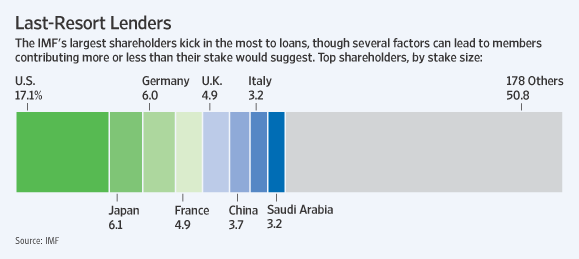
U.S. participation in the €110 billion ($145 billion) loan to Greece is relatively modest. The 15 nation euro-zone governments are ponying up $106 billion, divided according to their stake in the European Central Bank. Germany, for example kicks in $29 billion, with France good for $22 billion.

Of the $39 billion the IMF is participating in, the US is likely to kick in somewhere in the neighborhood of $3 billion dollars. Considering the US role in the global collapse, that is a relative bargain.


Source:

Who’s on the Hook for the IMF’s Greek Bailout?

BOB DAVIS

WSJ, MAY 5, 2010
http://online.wsj.com/article/SB10001424052748704866204575224421086866944.html

"

(Via The Big Picture.)

Tuesday, May 4, 2010

Guess Who's Going To Bail Out Greece?

The Great Reflation: "

Let me start this week’s Outside the Box by venting a little anger. It now looks like almost 30% of the Greek financing will come from the IMF, rather than just a small portion. And since 40% of the IMF is funded by US taxpayers, and that debt will be JUNIOR to current bond holders (if the rumors are true) I can’t tell you how outraged that makes me.

What that means is that US (and Canadian and British, etc.) tax payers will be giving money to Greece who will use a lot of it to roll over old bonds, letting European banks and funds reduce their exposure to Greece while tax-payers all over the world who fund the IMF assume that risk. And does anyone really think that Greece will pay that debt back? IMF debt should be senior and no bank should be allowed to roll over debt and reduce their exposure to Greek debt on the back of foreign tax-payers.

I don’t think I signed on for that duty. Why should my tax money go to help European banks? This is just wrong on so many levels and there is nothing seemingly we can do. Oh, well. Thanks for listening.

This week we look at an essay by my friend Tony Boeckh, who from 1968 until 2002, was chairman and editor-in-chief of BCA Publications, publisher of The Bank Credit Analyst. He has written a very important book called The Great Reflation. Tony feels that one of the most important things for investor to understand is money flows, whether from debt or monetary easing. The ebb and flow of money can both create and burst bubbles and we are now in what he calls a Great Experiment where governments around the world are trying to again reflate the economy (and are succeeding). What bubbles will this create and how does it end? How should we then invest?

My good friend Marc Faber has this to say about The Great Reflation:

The Great Reflation is by far the best economic and investment book that I have read in the last ten years. Tony is a seasoned historian, economist, and strategist with a unique ability to explain complex issues in simple, readable terms. These are illustrated with numerous charts on economic and financial trends that put current conditions in a historical context.’

- Marc Faber, Editor, The Gloom, Boom & Doom Report

The book is in most bookstores and you can of course get it by going to www.amazon.com and you save 34% and it is available on Kindle. So, let’s enjoy Tony’s essay.

Your never did like the IMF anyway analyst,

John Mauldin, Editor

Outside the Box

The Great Reflation:

The Mother of all Financial Experiments

By Tony Boeckh

Chuck Prince, the former CEO of Citigroup, who presided over the bank’s collapse, famously remarked in July 2007 that ‘as long as the music is playing, you’ve got to get up and dance. We’re still dancing.’ Shortly after, the music stopped, the financial system broke, and Citigroup and other financial behemoths went under.

To rescue the economy and financial system from near-total meltdown, the government created an unprecedented package of bailouts, stimulus, free money and massive fiscal deficits. It succeeded, and a 1930s style debt deflation and depression were aborted. Liquidity, on a vast scale was unleashed into the financial system, demonstrating, once again, the power of such flows to drive up the prices of stocks, commodities and other risky assets.

In Tony Boeckh we focus on how the authorities pumped air back into the balloon, and got the music playing again. Investors and banks, including Citigroup, are back out on the dance floor. However, just because the system was saved, doesn’t mean it has been fixed.

Why do we say that the system isn’t fixed? The major theme running through The Great Reflation is that we have been living through a multi-decade period of money and credit inflation that started back in the 1960s when the post-World War II global monetary system (Bretton Woods) began to break down. The Great Reflation is about this inflation and the consequences of the Act II, which is now unfolding.

From the late-1960s until 1982 we had out-of-control price inflation; after that, a series of asset bubbles and mini-crashes, leading up to The Big One in 2008-2009. One of the implications outlined in The Great Reflation is that we continue to live in an age of money and credit inflation and a monetary system that is unanchored and has no brakes. Until that is fixed, monetary inflation and instability will be a way of life.

The great reflation can only be understood properly in this longer-term context. It is a continuation of what went before, but with two main differences. The first is the sheer magnitude of the reflation this time—by far the biggest in peacetime U.S. history. The second difference is that the governments of the U.S. and other countries have had to transform collapsing private debt into a burgeoning public debt supercycle with projected government debt:GDP ratios heading to the stratosphere. This effort to reflate—pump air back into the balloon—had to be on a scale at least as large as the bubble itself. It is an experiment never before attempted in the context of U.S. experience, and it will have consequences unlike anything seen before.

No one knows exactly where the great reflation is going, what is going to happen, and what the end point will be like. However, there are some things we do know. When new money is created on a grand scale, it must go somewhere and have some major consequences. One of these will be greatly increased volatility and instability in the economy and financial system compared with the roller-coaster ride of the past 15 years when the private credit bubble was forming.

The Roller-Coaster

It is critical for investors to understand that there has been a linked sequence of events since the 1960s that lead to the disaster of 2008-2009. In particular, over the past 15 years, we experienced first the tech bubble, followed by a crash, then the recession and deflation of 2000-2002. Next came the Federal Reserve’s first effort at massive reflation to avoid a debt collapse. This led to new bubbles—in housing, exotic new financial products, commodity prices, energy, and world food markets. They were financed by an unprecedented credit bubble that was unsustainable. When the bubble burst, debt levels were much higher and more precarious than ever. In 2008-2009 asset prices were crushed, causing the collateral behind the debt to evaporate. That, in turn, is what triggered the mother of all reflation experiments.

This sequence of events has an ominous undertone. The great reflation effort has clearly given the economy a big boost, just as the preceding one did but it is very artificial, based on free money and unprecedented fiscal deficits and subsidies to spending.

Extrapolation of this out-of-control roller coaster suggests more bubbles in the short run. Hot markets have already begun forming in such things as commodities, gold, and world stock markets. There are many assets that could be recipients of the new money created. However, a warning for investors: We don’t believe another inflation of asset prices will last as long as the previous one for several reasons. Private debt has been pushed to the limit; government debt will be pushed to the limit in a few more years; the U.S. dollar, as the world’s main reserve currency, will not be able to withstand open-ended monetary and fiscal reflation; and finally, the world economy is too fragile to withstand another spike in energy and food prices which will certainly occur if monetary inflation continues.

The great reflation, if left unchecked, will run into a brick wall in the next few years, and another credit implosion and deep recession will occur. The result will be even bigger budget deficits and lower economic growth. Logic says that if the recent crisis was caused by excessive money and credit inflation, even more of the same should cause an even bigger crisis. The ultimate end point to this trend is worrisome, to say the least.

The Engine of Inflation

Inflation is the biggest enemy of investors in the long run. However, in the short term, inflation in its early stages is often a wonderful elixir, greasing the wheels of the economy and causing riskier assets like stocks, commodities and corporate bonds to levitate. Euphoria tends to build as people get richer. But, it is important to understand that inflation is an undue expansion of money and credit. It can have the effect of raising the prices of things we consume or the prices of assets that we own or want to buy. But those are the symptoms of inflation that, if extreme, tell us that a bust is coming. In the case of rising consumer prices, the central bank ultimately has to raise interest rates and curtail credit. Recession follows. Or, if asset prices rise on the back of credit expansion, debt servicing ultimately becomes unbearable and asset prices—the collateral—start to fall, but debt levels are fixed in the short term. When people can’t service or repay debt, panics and crashes follow, and the risk of a debt deflation and depression rises dramatically.

Too much debt and falling asset prices caused the depression of the 1930s and almost another one in 2008-2009. One Important reason that debt rose to such extremes, both in 1929 and 2007 was that the monetary system had a built-in inflationary bias. In the 1920s, it was called the gold exchange standard, whereby countries held both gold and currencies in their reserves. In the post-1971 world, it was called the floating dollar standard or Bretton Woods II. Countries held mainly dollars in their reserves. As a result, the U.S. could inflate at will and foreign countries had to buy the excess dollars on the foreign exchange market if they wanted to prevent their currency from rising. In a world of low and falling price inflation, as was the case after 1982, almost all countries want a cheap currency.

This is an important consequence of our flawed monetary system. Countries that buy dollars to keep their currency depressed, experience money and credit inflation. Bubbles result. When those countries re-invest their dollars back into the U.S., the U.S. financial markets remain highly expansionary. Lenders keep lending and borrowers keep spending beyond their means. In a fixed exchange rate system in which countries do not hold dollar reserves, a U.S. international payments deficit results in a drain on domestic liquidity until the deficit is corrected. In the current system, the U.S. can inflate and run huge balance of payments deficits with no pain and no mechanism to stop it, other than a financial panic. It is like a fast car with no brakes. Sooner or later a crash occurs.

This fundamental flaw in the international monetary system remains. The combination of this with the unleashing of the great reflation has created a toxic brew. There is little wonder that people fear even greater monetary instability in the future than we have experienced.

When looking for scapegoats to point the finger of blame for the crash, it is natural that people have looked to the appalling performance of the regulators. That is valid, and it is also right to highlight the greed-driven excesses of lenders and the virtually criminal conflicts of interest of the ratings agencies. But these characteristics—greed, conflict of interest and criminal behavior—are always present when inordinate inflations and manias occur. It is the inflation that is the real villain.

The Long Wave and Deflation

The money and credit inflation following the breakdown of the Bretton Woods I system in 1971 originated, we believe, from the deflationary forces of the long wave decline that became quite evident after 1973. The private debt supercycle build-up and overspending in the 1982-2007 period caused a countertrend, but artificial, recovery in some long wave economic forces. Employment, earnings and wealth in industries that benefitted from the credit inflation, such as real estate, the financial industry in general, retail spending, technology (from the 1990s bubble) rose quite strongly, masking the continued downward pressure on capital intensive industries and particularly, but not exclusively, in the capital goods industry itself. Growing excess capacity resulted. Middle-class incomes on average continued to erode and the gulf between rich and poor widened dramatically as in the late 1920s.

With the end of the private credit bubble, the long wave decline has resumed its downward course. No one knows how long that will last until the natural, Schumpeterian forces of long-term renewal take over. This would include the implementation of new technologies and the development of new industries. Our guess is that it could take another five years or so.

Policy and Markets

In The Great Reflation, we look at the inflationary causes of the credit bubble and the ensuing crash of 2008-2009 and the consequences of the massive monetary and fiscal program that was needed to abort an incipient debt deflation like the 1930s. The world, and in particular the U.S., will remain very deflationary for a few more years as the post-crash stimulus will soon begin to dissipate. The recovery engineered by the authorities will face additional headwinds from the unwinding of the private debt supercycle, the resumption of the long wave economic decline and the coming massive fiscal restraint. The U.S. and almost all other governments, at both national and lower levels (states, provinces, municipalities, hospitals, etc.) rein in expenditures and raise taxes. That is the new imperative—no one wants to hit the wall like Greece. However, massive fiscal restraint also carries risks, just as the lack of restraint causes risks of a different sort. The big issue is whether there exists a middle ground that could eventually bring us to stability. That will only be revealed in the fullness of time.

Spending and borrowing excesses of governments and the public have a long and dangerous history, suggesting a deeper malaise is affecting the nation. Moreover, there are other serious signs of long-term decline, and policy and leadership will have to be particularly adroit in steering the U.S. through the difficult few years ahead. It has been documented that the latter stages of a long wave decline are parochial, nasty and politically unstable. People are fed up with the system, their loss of wealth, jobs, and income. Traditional politicians are blamed. People look for quick and easy solutions and are open to simplistic solutions provided by demagogues. It is difficult to sell the austerity, sound policies and pro-growth strategies needed to transition through the long wave trough before really big crises occur. Countries in denial face the prospect of repeating Greece’s calamity.

The risk for the U.S. and other countries is that politicians will cater to populist pressures and impose spending and tax policies that are counterproductive. In the aftermath of the Great Reflation, this could mean more government programs (e.g. health care), failure to raise taxes, where appropriate, out of fear of losing office, and excessive monetary ease because the Treasury bond market cannot absorb government funding on its own.

However, we should avoid the temptation to get too pessimistic. It is important never to underestimate the ability of the U.S. to recover from adversity, rejuvenate itself and get its house in order. Its long-term track record is pretty good, and realistic hope should not be jettisoned too readily. The question remains however, as to whether the U.S. needs an economic Pearl Harbour before serious action is taken. Investors have seen empty promises many times before and hence should be sceptical until they see clear, positive evidence that such action is being taken. Until then, they should take the attitude ‘show me’.

The Investment Challenge

The great problem for investors in today’s environment is that there is no return on short-term, safe assets yet the higher risk levels on longer-term, higher return assets are too uncomfortable for most people. There are a number of conservative strategies that investors can employ, which are discussed at length in The Great Reflation and in our Boeckh Investment Letter (www.boeckhinvestmentletter.com), which, for lack of space, cannot be discussed here.

The centerpiece of our own strategy, and outlined in the book, is understanding liquidity flows. They are the single most important force driving investment markets both up and down. Contracting liquidity caused the crash in 2008-2009 and dramatically expanding liquidity since March 2009 has triggered one of the greatest bull markets in U.S. history. The next bear market will also be driven, at some point, by a contraction in liquidity flows. However, as long as the great reflation is doing its work, that day can be postponed. Chuck Prince, if he were to comment today, would probably point out that the music is playing again. People are back out on the dance floor. But, if the great reflation is as artificial as we believe, then this is still musical chairs. When the music stops, there won’t be a chair for everyone, just like the last time.

Disclaimer

John Mauldin is president of Millennium Wave Advisors, LLC, a registered investment advisor. All material presented herein is believed to be reliable but we cannot attest to its accuracy. Investment recommendations may change and readers are urged to check with their investment counselors before making any investment decisions."

(Via The Big Picture.)