Monday, November 30, 2009

Michael Brenner: Afghanistan: Obama Drops The Other Shoe

Michael Brenner: Afghanistan: Obama Drops The Other Shoe: "

The sham Afghanistan strategic review is now revealed for the empty exercise it always was. Escalation was inescapable, for Obama's staunch promotion of a 'necessary war' precluded a serious reappraisal of stakes and risks. Reversing himself would have demanded the kind of courage that is wholly foreign to him. So we are left with an open ended commitment to an unwinable war. That outcome speaks volumes about the failings of Obama as a leader as much as his impaired judgment.

The entire process reeks with dishonesty -- a double dishonesty. The White House deceived the country in advertising a root and branch critical analysis of the reasons for our engagement in Afghanistan that never took place. Also, the White House deceived itself in making believe that endless discussions over variations of the same strategy addressed core issues. All of the participants shared the same key assumptions that never have been questioned. Petraeus, Gates, Hillary, Jones, Biden, Holbrooke -- and Obama -- take as received wisdom four basic postulates: (1) the very existence of al-Qaeda's remnants constitutes a grave threat to American security; (2) the Taliban's agenda is fundamentally no different from al-Qaeda's, so they must be eliminated as a force in Afghan politics as well; (3) both groups can be suppressed by generous applications of military power; (4) the huge risks and costs of trying to do so are eclipsed by a dire threat to the United States. All of these highly dubious postulates have never been frontally addressed and debated.

What, then, did they spend two months and untold hundreds of hours debating -- including forty hours of Obama's direct participation? After all, the big questions of purpose and objective had been settled in the March review. One is hard pressed to give an answer. Probably these pow-wows entailed little more than repeated advocacies for 10,000 troops (Biden), 20,000 (Jones), or 40,000 (Petraeus, Hillary). A facsimile of the old Bud Lite beer commercials: chants of 'Less Filling' alternating with chants of 'Tastes Great.' Finally, Obama picked 30,000 + as a nice consensual number. All the evidence available suggests that this fateful decision for America's future indeed was taken in this feckless manner.

So what to make of all the talk about Obama's demanding fresh options, of 'off-ramps,' of an exit strategy? It looks to be nothing more than White House spin provoked by the embarrassing leak of Ambassador General Eikenberry's memo casting doubt on the strategic framework sketched above. It is now obvious that Obama's sudden 'rejecting' of the four options on the table, in light of Eikenberry's intervention, was just standard White House theatre. It is inconceivable that Obama was not already aware of Eikenberry's heretical views since the memo was written at the end of October; and, in any event, he surely knew his ambasador's thinking. My reading is that he chose to ignore those contentious ideas because they lay outside of the collective mindset fashioned by Petraeus/McChrystal and which Obama had signed onto. That explains the White House's fury at the leak of a skeptical viewpoint while tolerant of McChrystal's calculated leak of his escalation plan followed by public campaigning for it. This is vintage Obama, an exact copy of what he's done with Paul Volcker who was cast into the outer reaches of the financial policy universe because he was out of tune with Obama's chosen team of Rubin/Summers/Geithner et al. It was the leak of Eikenberry's memo that threw a wrench into the gears. No surprise then that we wind up with the original escalation plan only dressed out in fancy new packaging. The 9,000 troops ready for deployment within days were not awaiting Obama's return from China to get their gear together.

The country is ill served by a president who fails to meet his responsibility for the rigorous, open debate on matters of great consequence that he pledged and that is imperative for avoiding more dismal failure. What is the value of a 150 I.Q. when bereft of wisdom or conviction to guide it? Obama's audacity in pursuing his ambition is one thing; political and intellectual courage is quite another."

(Via Huffington Blog.)

Sunday, November 29, 2009

The Prosperity Gospel And The Subprime Collapse

The Prosperity Gospel And The Subprime Collapse: "It's staggering really that modern American Christianism supports wealth while Jesus demanded total poverty, fetishizes family while Jesus left his and urged his followers to abandon wives, husbands and children, champions politics while Jesus said his kingdom was emphatically not of this world, defends religious war where Jesus sought always peace, and backs torture, which is what the Romans did to Jesus."

(Via The Daily Dish | By Andrew Sullivan.)

Saturday, November 28, 2009

America Burps and Goes Shopping

America Burps and Goes Shopping: "Sentence of the day, from Whiskey Fire:

'...for a world-historical triumphant ideological titan, capitalism sure seems to need a shitload of silly propaganda to keep people believing in it.'

In particular, 'Black Friday' and 'Cyber Monday,'

...transparent attempts to create out of thin air holidays that are nakedly about nothing but celebrating consumer consumption at its rawest, most primal. Or, greedy. I observe in this regard that all local media in the NYC area yesterday sent reporters to the Valley Stream WalMart where raw consumer consumption last Black Friday got someone trampled to death. This year you will be relieved to know, as every goddamn local TV and radio station reported, nobody got killed on their way to enjoying the bargains they need in order to correctly celebrate the holiday that Fox News informs us is properly understood as a celebration of Christ, as opposed to something not Christian, but perhaps pagan, or maybe pro-big government and anti-free-market.

And people bitch about Kwanzaa being 'phony.' Maybe they should call it Cyber-Kwanzaa Wednesday and give everyone 15% off tube socks and Wiis. Legitimacy at last!

The Baltimore TV stations likewise dispatched perky reporterettes to the nearby malls to interview shoppers who had camped out for hours to take advantage of 'doorbuster' sales and were wheeling their loaded shopping carts to the parking lot, to feed the cargo space in their minivans and SUVs. It was all treated as wholesome, grinny, American ritual fun. But as I've said before and will say again, because it's my blog: None of these shopping mall parking-lot TV correspondents ever interview the floor employees and managers of these stores, who have to cut their holiday short to stock and get ready for ever more nightowlish openings (Kohl's, for example, opened its doors at 4 AM), or inquired about the additional security guards needed to ensure a riot doesn't break out once the flat-screen TVs or $199 laptops are sold out. Local station managers won't run the risk of ticking off local and national merchants, especially given the importance of all those 'doorbuster' ad sales. So each year the time-window closes tighter on Thanksgiving day, shrinking to a few hours for food and football before the retail dinosaur opens its jaws. This year in Maryland more convenience stores and small businesses seemed to be open on Thanksgiving, as if they couldn't afford to let their cash registers have even one day's rest in this rundown economy. Thanksgiving is evolving into a hazy hybrid holiday that resembles a higher calorie President's' Day with autumnal coloring."

(Via James Wolcott's Blog.)

Thursday, November 26, 2009

Colbert Conservatives and Military Waste

Colbert Conservatives and Military Waste: "By David Sirota

Every American will spend $2,700 on the military next year and the Pentagon ‘lost’ at least $1 trillion, but how dare you criticize the military?

READ THE WHOLE ITEM

"

(Via Truthdig: Drilling Beneath the Headlines.)

Wednesday, November 25, 2009

Jeff Cohen: Get Ready for the Obama/GOP Alliance

Jeff Cohen: Get Ready for the Obama/GOP Alliance: "

With President Obama pushing a huge troop escalation in Afghanistan, history may well repeat itself with a vengeance. And it's not just the apt comparison to LBJ, who destroyed his presidency on the battlefields of Vietnam with an escalation that delivered power to Nixon and the GOP.

There's another frightening parallel: Obama seems to be following in the footsteps of Bill Clinton, who accomplished perhaps his single biggest legislative 'triumph' -- NAFTA -- thanks to an alliance with Republicans that overcame strong Democratic and grassroots opposition.

It was 16 years ago this month when Clinton assembled his coalition with the GOP to bulldoze public skepticism about the trade treaty and overpower a stop-NAFTA movement led by unions, environmentalists and consumer rights groups. How did Clinton win his majority in Congress? With the votes of almost 80 percent of GOP senators and nearly 70 percent of House Republicans. Democrats in the House voted against NAFTA by more than 3 to 2, with fierce opponents including the Democratic majority leader and majority whip.

To get a majority today in Congress on Afghanistan, the Obama White House is apparently bent on a strategy replicating the tragic farce that Clinton pulled off: Ignore the informed doubts of your own party while making common cause with extremist Republicans who never accepted your presidency in the first place.

'Deather' conspiracists are not new to the Grand Old Party. Clinton engendered a similar loathing on the right despite his centrist, corporate-friendly policies. When conservative Republican leaders like Newt Gingrich and Dick Armey delivered to Clinton (and corporate elites) the NAFTA victory, it didn't slow down right-wing operatives who circulated wacky videos accusing Clinton death squads of murdering reporters and others.

For those who elected Obama, it's important to remember the downward spiral that was accelerated by Clinton's GOP alliance to pass NAFTA. It should set off alarm bells for us today on Afghanistan.

NAFTA was quickly followed by the debacle of Clinton health care 'reform' largely drafted by giant insurance companies, which was followed by a stunning election defeat for Congressional Democrats in November 1994, as progressive and labor activists were lethargic while right-wing activists in overdrive put Gingrich into the Speaker's chair.

A year later, advised by his chief political strategist Dick Morris (yes, the Obama-basher now at Fox), Clinton declared: 'The era of big government is over.' In the coming years, Clinton proved that the era of big business was far from over -- working with Republican leaders to grant corporate welfare to media conglomerates (1996 Telecom Act) and investment banks (1999 abolition of the Glass-Steagall Act).

Today, it's crucial to ask where Obama is heading. From the stimulus to health care, he's shown a Clinton-like willingness to roll over progressives in Congress on his way to corrupt legislation and frantic efforts to compromise for the votes of corporate Democrats or 'moderate' Republicans. Meanwhile, the incredible shrinking 'public option' has become a sick joke.

As he glides from retreats on civil liberties to health reform that appeases corporate interests to his Bush-like pledge this week to 'finish the job' in Afghanistan, an Obama reliance on Congressional Republicans to fund his troop escalation could be the final straw in disorienting and demobilizing the progressive activists who elected him a year ago.

Throughout the centuries, no foreign power has been able to 'finish the job' in Afghanistan, but President Obama thinks he's a tough enough Commander-in-Chief to do it. Too bad he hasn't demonstrated such toughness in the face of obstructionist Republicans and corporate lobbyists. For them, it's been more like 'compromiser-in-chief.'

When you start in the center (on, say, health care or Afghanistan) and readily move rightward several steps to appease right-wing politicians or lobbyists or generals, by definition you are governing as a conservative.

It's been a gradual descent from the elation and hope for real change many Americans felt on election night, November 2008. For some of us who'd scrutinized the Clinton White House in the early 1990s, the buzz was killed days after Obama's election when he chose his chief of staff, Rahm Emanuel, a top Clinton strategist and architect of the alliance that pushed NAFTA through Congress.

If Obama stands tough on more troops to Afghanistan (as Clinton fought ferociously for NAFTA), only an unprecedented mobilization of progressives -- including many who worked tirelessly to elect Obama -- will be able to stop him. Trust me: The Republicans who yell and scream about Obama budget deficits when they're obstructing public health care will become deficit doves in spending the estimated $1 million per year per new soldier (not to mention private contractors) headed off to Asia.

The only good news I can see: Maybe it will take a White House/GOP alliance over Afghanistan to wake up the base of liberal groups (like MoveOn) to take a closer and more critical look at President Obama's policies.


Jeff Cohen is an associate professor of journalism at Ithaca College and former board member of Progressive Democrats of America.

"

(Via Huffington Blog.)

Global Military & Defense Budgets

Global Military & Defense Budgets: "

Global Defense And Military Budgets


Via Global Issues:

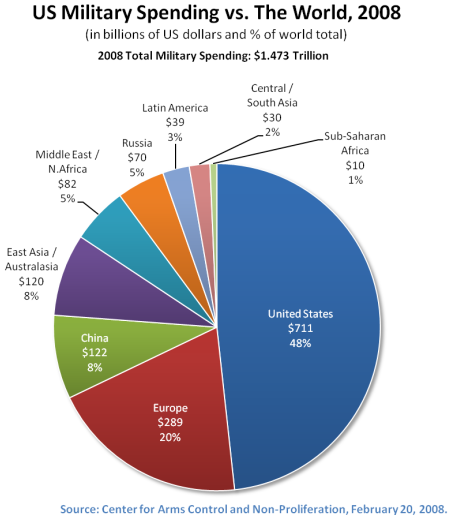
* World military expenditure in 2008 is estimated to have reached $1.464 trillion in current dollars

* This represents a 4 per cent increase in real terms since 2007 and a 45 per cent increase over the 10-year period since 1999;

* This corresponds to 2.4 per cent of world gross domestic product (GDP), or $217 for each person in the world;

* The USA with its massive spending budget, is the principal determinant of the current world trend, and its military expenditure now accounts for just under half of the world total

‘When you’re a hammer, everything looks like a nail’

"

(Via Prose Before Hos.)

Monday, November 23, 2009

The new AIG report reveals how Geithner—and U.S. taxpayers—were fleeced by Wall Street banks.

The new AIG report reveals how Geithner—and U.S. taxpayers—were fleeced by Wall Street banks.: "The issue has been festering for months: Why were AIG's counterparties—including Goldman Sachs, JPMorgan Chase, and UBS—paid 100 cents on the dollar when the feds rescued the insurance giant, helping raising the cost of the bailout to nearly $200 billion? A new report issued by Special Inspector General Neil Barofsky now reveals that government officials, notably then-New York Fed President and current Treasury Secretary Timothy Geithner, grievously damaged the nation and capitulated to the very banks they should have been supervising."

(Via Slate Magazine.)

Dan Dorfman: 2010 Could Wreak Havoc Again

Dan Dorfman: 2010 Could Wreak Havoc Again: "

Maybe I'll toast in the new year with beer, not champagne. Why so? Read on.

First, seeing is believing, not hearing is believing. It's worth keeping that in mind since with less than seven weeks to go before we're in 2010, you'll soon be bombarded in print and on TV with Wall Street's annual new year's forecasts.

Given a very respectable 3.5% economic growth rate in the third-quarter and a zippier stock market, with the Dow leaping to above 10,000 from its March low of about 6,550, you can be sure the predictions from the brokerage community will be decidedly rosy -- all designed to entice you to take more risk by pulling money out of low-yielding fixed income investments and pouring it into equities.

Expect to hear and read that we're definitely in the early stages of an unmistakable economic upturn and that 2010 will produce solid GDP growth, rising stock prices, a healthy rebound in housing and higher employment.

In fact, such happy talk is already making the rounds in initial 2010 forecasts. In an AOL interview, for example, officials of ING, the Dutch-based banking and insurance biggie, used many of these bullish arguments. In brief, it predicted about a 15% gain in stock prices next year on much peppier economic growth, with GDP gains of 2.8% in the first quarter, 3.4% in the second, 4% in the third and 4.4% in the fourth.

ING's exuberant message in a nutshell, which left no margin for error and went unchallenged by AOL: financially, 2010 will be a great year for America.

Hopefully so, but there are recurring and hellish signs out there that make it clear that the post recession recovery supposedly well under way is suspect and it may be way too soon to ring the all-clear bell.

On Manhattan's east side, for example, just a few blocks from the pricey Palm restaurant, a favorite dining spot for steak and lobster lovers, most of whom couldn't care less about the size of the bill, is a shoemaker's shop with a table just outside the entrance. On that table rests a bunch of new and reasonably new well shined men's shoes priced at $40 a pair that have been put up for sale since the previous owners apparently couldn't afford or wouldn't pay for the repairs.

This telling shoe experience about the financial vigor of the consumer is not what post-recession recoveries are all about. Nor, for that matter, are surging mortgage delinquencies, ballooning foreclosures, 53 straight weeks of unemployment claims above 500,000, non-stop layoffs and a slew of giant-sized discounts for holiday shoppers ranging from 25% to 75%.

It all provides a decidedly different and ominous perspective of the supposedly new post-recession recovery. What's more, it leads some skeptical pros to question whether the $14 trillion of household wealth that was lost in 17 months between October of 2007 and March of 2009 -- chiefly a reflection of a housing bust and the bloodbath in the stock market -- marked the end of the financial chaos. They say not.

One non-believer of the economic bull case is Madeline Schnapp, director of economics at West Coast liquidity tracker TrimTabs Research. Her basic view is 2010 will be a bummer, with unemployment shooting up to 11% in the summer and GDP for the year, if we're lucky, winding up between flat and up 1.5%. 'And if we're not lucky,' she says, maybe a decline of 1.5%.'

Unfortunately, at this stage in the recovery cycle, private sector demand, she points out, should be increasing and slowly replacing government-stimulated demand. Instead, she notes, despite trillions of dollars spent on the recovery, wages and salaries are falling, actual job losses are running 250,000 to 300,000 every month, employment demand is at its lowest level in over a decade, mortgage delinquencies are rising rapidly, revolving credit and revolving home equity loans are falling at the fastest pace in our records dating back to 1973 and corporate and industrial loan growth is also falling at the fastest pace in our records since 1973. Without private sector demand, Schnapp observes, the current recovery is simply not sustainable.

Rather than debate the shape of the recovery, she says, market pundits instead should be debating the size of the liquidity-fueled asset bubble, its duration and eventual demise.

What got the economy into trouble the last time around, Schnapp notes, was private sector credit expansion based on wildly inflated assets. It's ironic, she says, that in crafting a cure, the Federal government is engaged in precisely the same activity, expanding credit at the fastest pace in history. 'Is there a problem with this logic?' she asks. Her answer: 'We certainly think so.'

Martin Weiss, the head of Weiss Research in Jupiter, Fla., sees the 2010 economic recovery -- which he thinks will peter out after the first half -- as 'the weakest and shortest in 100 years.' Among the key reasons, he looks for a double-dip in housing, spurred by more foreclosures and another round of declines in home prices, say about 10%, and a continuing credit crunch, especially for consumers and small businesses.

Weiss also expects 2010 to produce a collapse in long term Treasury and corporate bonds, a further drop in the value of the dollar at a very rapid pace, continued money-printing by the Fed until it's forced to stop, more stock market pain as investors realize the U.S. economy is a sinking economy, a surge in interest rates and a rise in the price of gold to about $1,500 an ounce.

Internationally, Weiss looks for the economies of China, India and Brazil to grow four times faster than the U.S. economy. At the same, he also expects the stock markets of the three overseas nations to grow five times faster than the Dow.

The bottom line from our skeptics, as far as the U.S. populace goes: Watch your financial back in 2010. It's worth noting that a couple of legendary Western figures, Jesse James and Wild Bill Hickok, failed to watch their back, and it cost them their lives.


What do you think? Write me at DandorDan@aol.com

"

(Via Huffington Blog.)

Saturday, November 21, 2009

Moyers on the Quagmires

Moyers on the Quagmires: "John Nichols Bill Moyers, who was at President Lyndon Johnson's side when the disastrous decision to escalate US presence in Vietnam was, spoke Friday night to President Barack Obama about what could be an equally disastrous escalation in Afghanistan."

(Via The Nation: Top Stories.)

Bob Herbert: An American Catastrophe

Op-Ed Columnist: An American Catastrophe: "Detroit and its environs are suffering because of policies that resulted in the implosion of crucially important components of America’s manufacturing base."

(Via NYT > Opinion.)

Friday, November 20, 2009

Afghanistan - Salon.com

Afghanistan - Salon.com: "The pressure is on President Obama to act quickly in Afghanistan. But why?"

(Via Salon.)

Saturday, November 14, 2009

The real deficit hawks

The real deficit hawks: "Critics decry the healthcare bill as fiscally irresponsible. Where's the outrage over the defense budget?"

(Via Salon.)

Friday, November 13, 2009

More Deficit Idiocy

More Deficit Idiocy: "Fiscal conservatism and deficit concern is nearly always code speak in Washington for something else: sometimes it's class warfare, or just a cheap partisan attack. Most often, when someone in Washington says they're concerned about the deficit, what they're really saying is "I would like to make sure we have a government that focuses maximally on blowing people up."

(Via The Nation: Top Stories.)

Why Are Hawkish Lawmakers Willing To Pay For An Escalation Of The War But Not For Health Care?

Why Are Hawkish Lawmakers Willing To Pay For An Escalation Of The War But Not For Health Care?: "

lolieberman


In recent days, heated policy discussions in Washington have largely focused on two topics: a possible escalation of the war in Afghanistan and health care legislation. Both a troop escalation and health care legislation carry significant price tags: roughly $100 billion and $80-$100 billion a year respectively. (It should be noted that health care reform, unlike a troop surge, would cut the deficit.)

In his New York Times column today, columnist Nicholas Kristof asks why hawks claim health reform is ‘fiscally irresponsible’ while enthusiastically supporting a troop surge in Afghanistan, given the fact that fixing our broken health care system is, unlike a troop surge, essential to the health and well-being of Americans:

The health care legislation pays for itself, according to the Congressional Budget Office, while the deployment in Afghanistan is unfinanced and will raise our budget deficits and undermine our long-term economic security.

So doesn’t it seem odd to hear hawks say that health reform is fiscally irresponsible, while in the next breath they cheer a larger deployment of troops in Afghanistan?

Meanwhile, lack of health insurance kills about 45,000 Americans a year, according to a Harvard study released in September. So which is the greater danger to our homeland security, the Taliban or our dysfunctional insurance system?

Indeed, hawkish legislators have lined up to both demand a costly surge in U.S. troops in Afghanistan while at the same time claiming that deficit-cutting health care legislation would simply be too expensive:

Sen. Joe Lieberman (I-CT) has called for providing the ‘resources [needed]’ for a ‘significant increase in U.S. forces’ while warning that he is ‘really worried about what [health care reform] would do to the deficit.’ [9/13/09, 10/26/09]

Sen. Mitch McConnell (R-KY) has complained that passing health care legislation would ‘expand government spending even more,’ while also boasting of his Republican caucus’s ‘broad support’ for any troop increase in Afghanistan. [10/21/09, 10/11/09]

Sen. John McCain (R-AZ) wrote a letter to President Obama stating that we ‘urgently need more resources’ in Afghanistan, ‘including more combat troops,’ while at the same time claiming that passing health care legislation would be tantamount to ‘generational theft’ that would run up ‘unconscionable and unsustainable deficits.’ [11/10/09, 8/27/09]

Kristof’s question bears answering. Why is it that hawkish lawmakers are so willing to spend such enormous resources in both lives and treasure on a troop surge in Afghanistan that is increasingly opposed by Americans and Afghans, but are so quick to bark at the price tag of health care legislation that could save the lives of the 45,000 Americans who die every year because they don’t have access to health care? As Glenn Greenwald notes, ‘Urging that more Americans be sent into endless war paid for with endless debt, while yawning and lazily waving away with boredom the hordes outside dying for lack of health care coverage, is one of the most repugnant images one can imagine.’

"

Wednesday, November 11, 2009

Why the last decade has been an economic disappointment for most Americans.

Why the last decade has been an economic disappointment for most Americans.: "As we dig out from the rubble of the financial sector's collapse, it's common to hear analysts fret that the United States may now be facing a Japan-style 'lost decade.' Throughout the 1990s, after its real estate and stock bubble burst, Japan struggled with low growth for more than 10 years. It emerged from the decade shrunken and sapped of confidence, with very little to show for a large amount of government spending and near-zero interest rates.

[more ...] "

(Via Slate Magazine.)

Tuesday, November 10, 2009

Bob Herbert: A Word, Mr. President

Op-Ed Columnist: A Word, Mr. President: "Health care reform is important, but President Obama’s priorities should be putting Americans back to work and ending the war in Afghanistan."

(Via NYT > Opinion.)

What Warren Buffett's Investment Says About the Global Economy

What Warren Buffett's Investment Says About the Global Economy: "

The G20 Finance Ministers and Central Bank governors are meeting today in St. Andrews, talking about the data they will need to look at in order to monitor each other’s economic performance and sustain growth (seriously).

The underlying idea is that if you talk long enough about the U.S. current account deficit and the Chinese surplus, stuff happens and the imbalances will take care of themselves--or move on to take another form.

Warren Buffett seems to agree.

Buffett’s big investment in railroads looks like a shrewd way to bet on growth in emerging markets--which is where most incremental demand for U.S. raw materials and grain comes from. It’s also a polite way to bet against the dollar or, even more politely, on an appreciation of the renminbi.

When China finally gives way to market pressure and appreciates 20-30 percent, their commodity purchases will go through the roof. You can add more land, improve yields, or change the crop mix of choice (as relative prices move), but it all has to run through Mr. Buffett’s railroad.

Of course, Buffett is nicely hedged against dollar inflation--this would likely feed into higher inflation around the world, and commodities will also become more appealing.

And Mr. Buffett is really betting against the more technology intensive, labor intensive, and industrial-based part of our economy. If that were to do well, the dollar would strengthen and resources would be pulled out of the commodity sector--the more ‘modern’ part of our production is not now commodity-intensive.

The G20 will stand pat, waiting for the recovery and hoping for the best; ‘peer review’ will turn out to be meaningless. But this raises three dangers.

1. China will overheat, with capital inflows fuelling a giant credit boom. Books with titles like China as Number One and The China That Can Say No will appear. The boom-bust cycle will resemble that of Japan in the 1980s--you don’t need a current-account deficit in order to experience a costly asset price bubble. Other emerging markets may follow a similar pattern (think India, Brazil, Russia).

2. U.S. and European banks will be drawn into lending to China and other emerging markets, directly or indirectly. In a sense this would be a re-run of the build-up of debt in Latin America and Eastern Europe in the 1970s, leading to the debt crisis of 1982 (remember Poland, Chile, Mexico). Banks with implicit government guarantees will lead the way.

3. We hollow out the middle of the global economy--with a few people doing ever better and most people struggling to raise their living standards. Increasing commodity prices hit hard at poorer people everywhere (recall the effects of the relatively mild run-up in food and energy prices in the first half of 2008). Global volatility of this nature helps big business but at the cost of undermining the middle class.

By betting on commodities, Mr. Buffett is essentially taking an ‘oligarch-proof’ stance. Powerful groups may rise to greater power around the world, fighting for control of raw materials and driving up their prices further. As long as there is growth somewhere in emerging markets, on some basis, Mr. Buffett will do fine.

As for the G20, they are already a long way behind the curve."

(Via The Plank.)

Saturday, November 7, 2009

America Performs its Familiar Role of Propping Up a Dictator

America Performs its Familiar Role of Propping Up a Dictator: "

Karzai


By Robert Fisk

Could there be a more accurate description of the Obama-Brown message of congratulations to the fraudulently elected Hamid Karzai of Afghanistan? First the Palestinians held fair elections in 2006, voted for Hamas and were brutally punished for it – they still are – and then the Iranians held fraudulent elections in June which put back the weird Mahmoud Ahmadinejad whom everyone outside Iran (and a lot inside) regard as a dictator."

READ THE WHOLE ITEM

(Via Truthdig: Drilling Beneath the Headlines.)

Tuesday, November 3, 2009

Reconstruction for the USA

Reconstruction for the USA: "

Ryan Avent asks what would happen if for just one year we spent as much on infrastructure investments as we do on the Department of Defense:

With that kind of money you could entirely build out a national network of true high-speed rail. One year’s worth of defense spending gets you that. Which makes one wonder: where are all the economists, wringing their hands over cost-benefit analyses of these defense expenditures? Does anyone doubt that the net benefit of $100 billion spent on high-speed rail is easily higher than that for the last $100 billion spent on defense? Have a look at this if you’re unsure.

And while the gains to new investments in infrastructure (and not just in transportation) would be large, it isn’t as though we lack critical needs. What was the cost, human and economic, of the I-35 bridge collapse? Of the Metro crash and resulting limitations on service? Of the Bay Bridge shutdown? And of course, investments in infrastructure constitute positive contributions to the economy, which ultimately strengthen our ability to direct resources toward defense. Aimless defense spending, on the other hand, may well make us poorer and less secure.

Ryan’s link was to my post comparing America’s 2007 defense spending to other countries:


defensespendingcontext


Under the circumstances, I think it’s clear that the marginal dollar spent on defense has a very low value. And of course though Ryan’s thought-experiment is a fun exercise, you couldn’t build out a national HSR network in one year no much how much money you spent. So the real point would be something like if we took 10 percent of the defense budget and re-allocated that to infrastructure, we could have a national HSR network in ten years. And we’d still be spending over triple what our nearest rival spends.

Something worth noting is that for a hegemonic power suffering from slow-but-steady (but very slow) relative decline, wasting money on national security expenditures actually erodes our hegemony. Meaningful U.S.-Chinese security competition is a generation or two away. By that time, money that was spent in 2009 on fighter planes or nuclear submarines or transportation infrastructure in Afghanistan isn’t going to be doing us any good. By contrast, spending money on preschool in 2009 does improve the U.S.-Chinese balance of power in 2049—investment in early childhood education pays enormous dividends, but it takes a long time to turn tiny babies into productive adults. And transportation is just the same. The construction of heavy rail mass transit in Boston, New York, Chicago, and Washington was extremely expensive but has paid consistent dividends for decades and if properly maintained will continue to do so forever.

I can’t vouch for the authenticity of the quote, but someone told me he heard a Chinese official tell him ‘over the past decade you’ve spent $1 trillion on Iraq and Afghanistan, we’ve spent $1 trillion building the future of China.’ I don’t really think we should view that contrast in a paranoid light, but if you do want to take a paranoid view of the American national security situation it makes a lot more sense to worry about that than to worry that someone in a cave might build a bomb. "

(Via Matthew Yglesias.)

Arianna Huffington: Obama One Year Later: The Audacity of Winning vs. The Timidity of Governing

Arianna Huffington: Obama One Year Later: The Audacity of Winning vs. The Timidity of Governing: "How did the candidate who got into the race because he'd decided that 'the core leadership had turned rotten' and that 'the people were getting hosed' become the president who has decided that the American people can only have as much change as Olympia Snowe will allow?

How did the candidate who told a stadium of supporters in Denver that 'the greatest risk we can take is to try the same old politics with the same old players and expect a different result' become the president who has surrounded himself with the same old players trying the same old politics, expecting a different result?

How could a president whose North Star as a candidate was that he 'would not forget the middle class' choose as his chief economic advisor a man who recently argued against extending unemployment benefits in the middle of the worst economic times since the Great Depression?"

(Via Huffington Blog.)